Lead Generation5 min read
Why Most Manufacturing Companies Struggle to Grow Beyond Referrals
Referrals built the business. Then one quarter the phone rings less. Here is why referral-only growth hits a ceiling, and what sits on the other side of it.

Sagar MamureMechanical engineer turned marketer · Founder, Marketing Mantra
The quarter the phone stops ringing
Your phone rings. It is a referral from an existing client. You quote, win the job and deliver. This has been your growth engine for ten, fifteen, maybe twenty years.
Then one quarter the phone rings less. Your best client is acquired and switches vendors. A competitor undercuts you on a bid you expected to win.
And you realise that you do not actually have a marketing system. You have a hope system, and it has just run out of luck.
This is a wall many manufacturing companies hit, not because their products are poor or their engineering weak, but because referrals built the business and referrals alone cannot scale it.
Why are referrals not a strategy?
Referrals are a side effect of good work, not a repeatable system.
Someone trusts you enough to vouch for you. That is a real asset. But it is reactive, and you do not control:
- When a referral happens
- How many arrive in a quarter
- Which industries or order sizes they come from
- Whether they arrive at all during a slow season
A business built entirely on referrals has no demand-generation engine. You are not attracting buyers; you are waiting for happy clients to remember you.
Why is your website a brochure, not a lead generator?
Many manufacturing websites were built years ago to look professional when someone searched the company name after a referral call.
They were never built to:
- Rank for the searches a new buyer would type
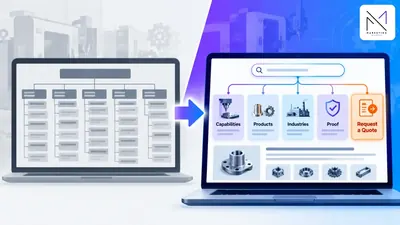
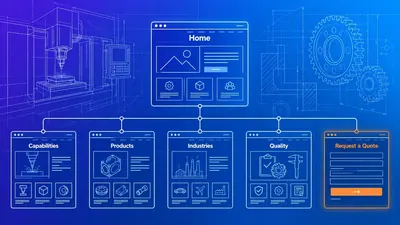
- Explain capabilities so a procurement engineer can check the fit
- Capture an enquiry before the buyer moves to the next supplier on the list
If your website’s only job is to confirm that you are a real company, it is a digital visiting card.
Read whether your manufacturing website is losing leads to change that.
Why can’t new buyers find you?
Because you only exist to people who already know your name.
Search for your own capability and look at who appears:
If it is not you, a buyer with budget, intent and an open RFQ may be finding your competitor, not because they are better, but because they are visible. Search engine and AI search visibility are how many buyers find new vendors when their existing network runs dry.
Why does nothing capture demand outside your network?
Referrals only reach people one step away from your current clients.
New factories, new industries, export buyers and second-generation owners taking over family businesses have no easy way to discover you. A marketing system adds several ways in:
Search-friendly articles
Answers to buyer questions that rank in search.
LinkedIn content
Builds authority with decision-makers.
A converting website
Turns visitors into enquiries.
A CRM
Tracks every enquiry so nothing slips through.
Why doesn’t founder-led trust scale on its own?
Because in manufacturing, buyers trust people, and that trust needs reach.
Referrals work because someone vouches for the founder or the team. The fix is not to abandon that dynamic but to extend it. When a founder shares real insight on LinkedIn, such as how RFQs are evaluated, what mistakes buyers make, or how pricing really works, they do digitally what a referral does in person: build trust before the first call.
Read our guide to LinkedIn marketing for manufacturers for a practical start.
Why does growth without a system mean growth without control?
Referral-only businesses grow in bursts followed by droughts.
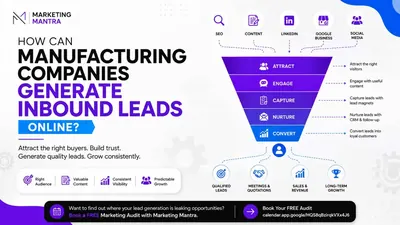
That makes it hard to forecast revenue, plan hiring or invest in capacity with confidence. A marketing system, built from SEO, content, LinkedIn, a converting website and a CRM, gives you a steadier and far more visible pipeline.
Referral-only growth
- Unpredictable bursts and droughts
- One fragile channel
- Invisible to new buyers
- Hard to plan capacity
Referrals plus a system
- Referrals still countThey sit alongside new channels
- Several ways for buyers to find you
- Every enquiry tracked
- A steadier, visible pipeline
What is the real question?
It is not “should we do marketing?” It is: how exposed is our revenue if referrals slow down for two quarters?
For many manufacturers, the honest answer is “quite exposed”. The good news is that this is fixable, and it does not require becoming a different kind of company.
How dependent are you on referrals?
5 of 5 unticked. Your growth depends heavily on referrals. A free audit will show where to start building.
Summary
- Referrals built your business, but they cannot scale it on their own.
- They are reactive, unpredictable and limited to your existing network.
- Without visibility and lead capture, buyers outside that network never find you.
- The fix is a system of SEO, LinkedIn, a converting website and a CRM that sits alongside referrals.
Frequently asked questions
We have grown on referrals for 15 years. Why fix something that is not broken?
Referrals are not broken. They are just not a system. They work until a key relationship changes. Building a marketing engine now means you are not starting from zero when that happens.
Is marketing too expensive for a company our size?
Marketing built for manufacturers, such as SEO, LinkedIn and founder-led content, can be modest in cost compared with a slow quarter with no new pipeline. The investment is mainly in visibility and lead capture, not heavy ad spend.
We are not consumer-facing. Does SEO apply to us?
Yes. B2B buyers, procurement teams and export clients often begin their supplier search on Google, and increasingly in AI tools.
Who has time to write articles and post on LinkedIn?
You do not need to become a content creator. You need a system that turns your existing expertise into structured content, built around your schedule.
Sagar Mamure is the Founder and CEO of Marketing Mantra, a Pune-based marketing, sales and branding consultancy for manufacturing SMEs. A mechanical engineer turned marketer, he helps factories turn their websites and LinkedIn into steady sources of RFQs. Connect on LinkedIn.