
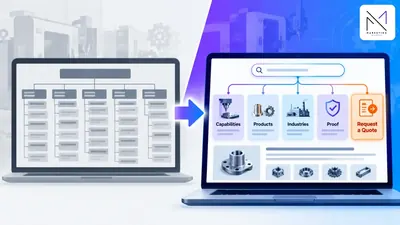
Manufacturing Website Design: Build Around How Buyers Search, Not Your Org Chart
Buyers search for what they need to make. Most factory websites describe how the company is organised. Here is how to close that gap in 5 steps.
Digital Presence · Manufacturing Website Development
Your website often runs the first meeting with a new buyer, before anyone calls you. We build sites that state what you make, to what specification, for which industries, and make it easy to send a drawing.
Sound familiar?
Menus such as “Our Group” or “Divisions” describe your company. Buyers look for processes, products and industries.
“State-of-the-art infrastructure” persuades nobody. A machine list with make, model and bed size does.
If sending a requirement takes more than a minute, or the form cannot accept a drawing, many buyers simply move on.
Owners and purchase managers often open your link from WhatsApp or LinkedIn on a phone. Heavy sliders and oversized images cost you that first impression.
Scope
The exact scope is agreed after the audit. These are the building blocks we draw from.
Pricing
Packages start at ₹12,000 a month. Here is what this service covers in each one. A new website or a full rebuild is quoted separately, because it depends on the number of pages, content and integrations. The monthly packages cover ongoing website improvement recommendations.
| Deliverable | Foundation | Growth | Scale |
|---|---|---|---|
| Monthly fee | ₹12,000 | ₹22,000 | ₹40,000 |
| One-time setup | None | ₹10,000 to ₹12,000 | ₹15,000 to ₹20,000 |
| Website recommendations | Basic | Detailed | Detailed |
Connected to sales
A website should do part of your sales engineer’s job: answer the routine questions, show proof, qualify the fit and capture the requirement. We design every page to end with a clear next step, and route enquiries to a named person so none of them sit in a shared inbox.
Process
Review your current site, analytics, enquiry routes and the questions your sales team hears most.
Agree the sitemap, the priority pages and what can be reused. Often a restructure beats a rebuild.
Write, design and build, collecting specifications and real photographs from your team.
Track RFQs by page after launch and improve the pages buyers actually use.
FAQ
Not always. If your current site is reasonably fast, works on mobile and is easy to edit, restructuring it and adding real capability content may be the better first step. We will tell you which applies.
It depends mostly on how quickly technical content, specifications and photographs are available from your team. We agree a timeline after the audit rather than quoting one blindly.
Put them on the page as text and tables, then offer the PDF as a download. Buyers, search engines and AI tools all read web pages more easily than PDFs.
We avoid them for anything that represents your shop floor. Buyers want to see your machines and parts. If photographs are not ready, we use clean diagrams instead of misleading imagery.
Further reading
Buyers search for what they need to make. Most factory websites describe how the company is organised. Here is how to close that gap in 5 steps.
A manufacturing website generates enquiries when it does five things well: shows what you make in five seconds, proves you can deliver, makes the RFQ easy, loads fast on mobile and can be found.
Free · 10 to 15 minutes · Built for manufacturers
The free Manufacturing Growth Audit scores six connected systems, from visibility to follow-up, and gives you a prioritised action plan. It takes about 10 to 15 minutes.