Websites9 min read
Manufacturing Website Design: Build Around How Buyers Search, Not Your Org Chart
Buyers search for what they need to make. Most factory websites describe how the company is organised. Here is how to close that gap in 5 steps.

Sagar MamureMechanical engineer turned marketer · Founder, Marketing Mantra
A buyer's Monday morning
A purchase engineer at an auto component OEM in Chakan needs a new supplier for aluminium housings. Her current vendor keeps missing deliveries, so she needs a backup fast. She types into Google:
She clicks your site. This is what she sees:
No mention of 5-axis machining or housings. She hits back in seconds.
Within seconds, she calls your competitor instead.
That is the real cost of poor manufacturing website design, and it is why so many factories lose at industrial SEO. Your website follows your org chart. Her search follows her problem. The two never meet.
This guide shows you how to fix that: why factory websites end up looking like company brochures, how industrial buyers actually search, and a simple 5-step method to rebuild your site around buyer searches.
What is an “org chart website”?
An org chart website is a site organised the way your company works internally, instead of the way buyers look for suppliers.
The menu mirrors departments, divisions and management layers. Consequently, the pages talk about who you are, not what the buyer needs.
Here is how you spot one:
- Menu items like “Our Group”, “Divisions”, “Board of Directors” or “Vision and Mission”
- One “Products” page with 30 or 40 items crammed together
- Page titles that use internal names, such as “Unit 2” or “Precision Division”
- No dedicated page for any single process, product line or industry
- A contact option that sits only at the end of the menu
A buyer does not care which division makes a part. They care whether you can make it, to their tolerance, in their material, on their timeline.
Why do so many manufacturers build websites around their org chart?
Most manufacturers build org chart websites because the website starts as a copy of the company brochure.
The owner hands over the brochure, the agency turns each section into a page, and the site goes live. As a result, the structure follows the brochure, and the brochure follows the company.
Three other reasons show up often when I audit factory websites across the Pune, Nashik and Aurangabad belt:
Internal teams write the brief
Each division head wants a page, so the menu grows by department.
Nobody asks the sales team
Your sales engineers hear buyer questions every day. However, they rarely get a say in the website.
Owners treat the website as a formality
Many still see it as a digital visiting card, not a sales channel.
I understand this thinking. I am a mechanical engineer, and engineers naturally organise things by system and function. But buyers do not read your website like an engineering drawing. They read it like a search result.
How do industrial buyers search for suppliers today?
Industrial buyers search for what they need to buy, not for who you are.
They type a process, a product, a material, an industry or a location. Very often, they combine several of these in one search.
Buyers also do most of this research alone:
67%
of B2B buyers prefer a rep-free buying experience
45%
of B2B buyers used AI during a recent purchase
Source: Gartner sales survey, March 2026
In other words, your website and your AI search visibility now run the first sales meeting for you.
Org chart labels vs real buyer searches
| Your org chart label | → | What the buyer searches | Page you need |
|---|---|---|---|
| → | “CNC turned components manufacturer” | Capability: CNC turning | |
| → | “sheet metal fabrication Chakan MIDC” | Capability + location | |
| → | “hydraulic cylinder for tipper trucks” | Product line page | |
| → | “auto component supplier for EV OEMs” | Industry: Auto and EV | |
| → | “5-axis VMC machining capacity” | Machine list with specs | |
| → | “IATF 16949 certified machining company” | Certifications page |
Notice the pattern. The left column describes your company, while the right column describes the buyer’s need. Good manufacturing website design builds pages for the right column.
What does buyer-first manufacturing website design look like?
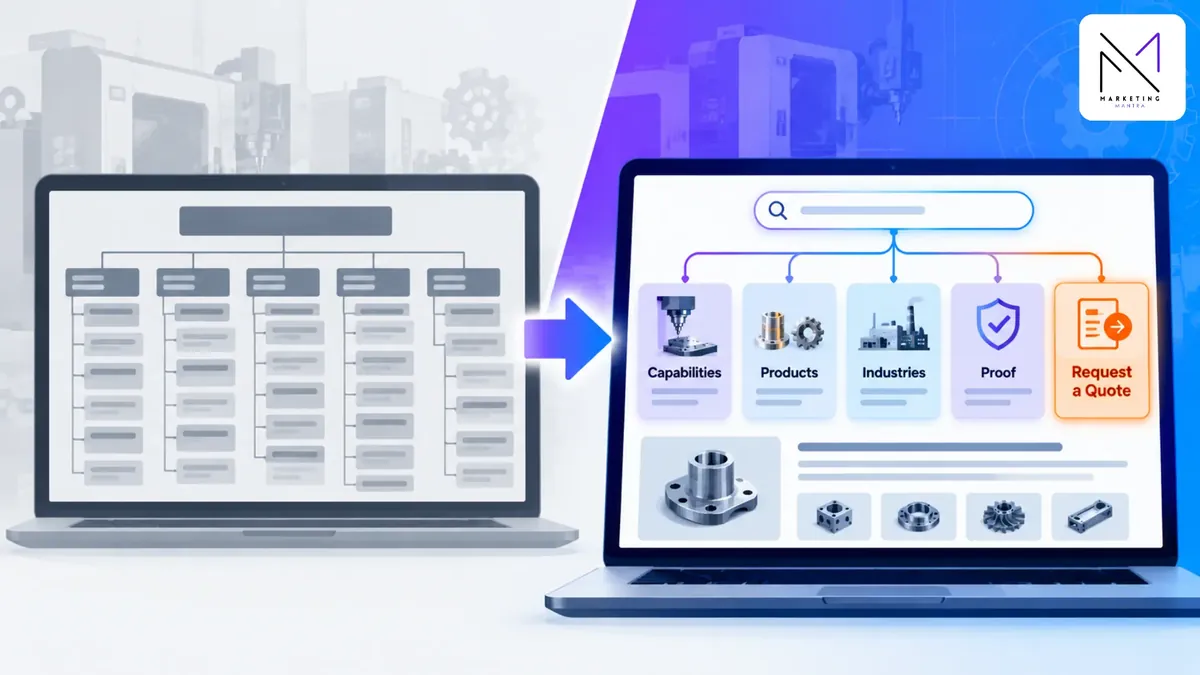
Buyer-first manufacturing website design organises the menu and pages around four things buyers search for: capabilities, products, industries and proof.
Everything else supports those four. Here is the same factory, before and after:
Org chart menu
- Home
- About Us
- Our Group
- Divisions
- Management
- Infrastructure
- Contact Us
Buyer-first menu
- Home
- CapabilitiesCNC Turning, VMC Machining, Laser Cutting, Assembly
- ProductsOne page per product line
- IndustriesAutomotive, EV, Agriculture, Pharma Machinery
- Quality and Certifications
- Case Studies
- Request a QuoteButton visible on every page
Your “About Us” page still exists. However, it moves to the footer or a secondary menu. Buyers check it after they confirm you can make their part, not before.
Every page opens with a direct answer
Here is what the top of a good capability page looks like:
Illustrative example. Use your own real specifications and certifications.
Right below the headline, the first line states tolerance, part size range, materials and monthly capacity. That way, the buyer knows within seconds whether you fit.
How do you rebuild your website around buyer search?
You rebuild your website around buyer search by collecting real buyer language first, then mapping pages to it.
Here is the 5-step method:
Collect real buyer language
Pull 20 to 30 recent RFQ emails, IndiaMART or TradeIndia enquiries, and WhatsApp questions. Also open Google Search Console and export the queries people already use to find you. Write down the exact words buyers use.
Group searches into four buckets
Sort every phrase into capability, product, industry or proof.
“laser cutting SS304” → capability · “ISO certified fabricator” → proof
Rename your menu in buyer words
Replace “Precision Division” with “CNC Turning”. Similarly, replace “Unit 2” with “Sheet Metal Fabrication”. If a buyer would not type the label into Google, it does not belong in your main menu.
Rewrite the first line of every page
Each page should answer its search in the first sentence. State what you make, for whom, to what specification and where, so both buyers and search engines understand the page instantly.
Put proof and the RFQ next to every claim
Add machine lists, tolerances, certifications and a short case study where buyers need them. Then place a “Request a Quote” button with drawing upload on every page, not just the contact page.
How long does the restructure take?
Steps 1 to 3 need only a few days of focused work. Steps 4 and 5 take longer, because they need real content, photographs and data from your team.
How does buyer-first structure help industrial SEO and AI search?
Buyer-first structure is the foundation of industrial SEO, because every page now targets one clear search.
Google can match “CNC turning Pune” directly to your CNC turning page. Before, it only had a crowded products page to guess from.
AI search tools work the same way. ChatGPT, Perplexity and Google AI Overviews pull answers from pages that state facts clearly. A capability page that lists tolerances, materials and certifications gives them something to quote. A “Vision and Mission” page does not.
For the full page-by-page sitemap and keyword map, read our guide to industrial SEO and manufacturing website structure.
What mistakes should you avoid when you restructure your website?
The biggest mistake is renaming menu items without adding real content underneath.
A “CNC Turning” page with two lines of text will not rank, and it will not convince a buyer either. Also watch out for these:
Thin pages
Every page needs specifications, applications, photos of real parts, and proof.
Stock photos
Buyers want to see your shop floor and your machines, not a generic robot arm.
Missing redirects
When you rename or delete old pages, set up 301 redirects so you keep any rankings you already have.
A hidden RFQ
If requesting a quote takes more than two clicks, many buyers simply leave.
Vague language
Specific beats impressive every time.
“Solution provider for diverse engineering needs”
“CNC machined parts up to 500 mm, ±0.01 mm tolerance”
Take the 5-minute org chart test
You can check your own website in five minutes.
Open your homepage on your phone. Tick every statement that is true for your website:
Your org chart test
5 of 5 unticked. Your website probably follows your org chart. A free audit will show you what to fix first.
If two or more stay unticked, your website probably follows your org chart. The good news is that the fix rarely needs a brand-new website. Usually, it needs a new structure.
Summary
- Poor manufacturing website design mirrors your org chart, while buyers search by process, product, industry and location.
- Gartner found that 67% of B2B buyers prefer to buy without a sales rep, so your website now runs the first sales meeting.
- Build your menu around four buckets: capabilities, products, industries and proof.
- Open every page with a direct answer, and put a Request a Quote button on every page.
- This structure also powers industrial SEO and makes your company easier for AI search tools to find and quote.
Frequently asked questions
What is buyer-first manufacturing website design?
Buyer-first manufacturing website design organises pages around what buyers search for, such as processes, products and industries, instead of internal departments. Each page answers one specific search. As a result, buyers find what they need faster and Google ranks the right page.
Do I need a new website to fix an org chart structure?
Usually not. You can restructure most WordPress websites by renaming menus, splitting crowded pages, and adding capability and industry pages. A full rebuild only makes sense if the site is very slow, not mobile-friendly or impossible to edit.
Should I remove the About Us page?
No. Keep it, but move it out of the prime menu position. Buyers check your background after they confirm you can make their part, so About Us works well in the footer or a secondary menu.
How do I find out what my buyers search for?
Start with Google Search Console, which shows the real queries that already bring visitors to your site. Then review recent RFQ emails, portal enquiries and the questions your sales team hears. The exact words buyers use should become your page titles.
How long does it take to see results after restructuring?
For specific local searches like “laser cutting Chakan MIDC”, you may see movement within a few weeks to a few months after Google recrawls your pages. Broader national searches take longer, and rankings are never guaranteed. Track enquiries and Search Console impressions every month.
Does website structure affect how ChatGPT describes my company?
Yes. AI tools prefer pages with clear, specific facts they can quote. Dedicated capability and industry pages with specifications and certifications give them those facts, while vague brochure pages leave them guessing, or pointing buyers to a competitor.
Sagar Mamure is the Founder and CEO of Marketing Mantra, a Pune-based marketing, sales and branding consultancy for manufacturing SMEs. A mechanical engineer turned marketer, he helps factories turn their websites and LinkedIn into steady sources of RFQs. Connect on LinkedIn.