SEO8 min read
Industrial SEO: How a Manufacturing Company Should Structure Its Website Around Buyer Search
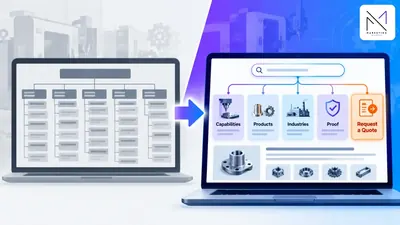
Industrial SEO starts with structure, not blog posts or backlinks. Each product, process, industry and proof point a buyer might search for needs a page of its own.

Sagar MamureMechanical engineer turned marketer · Founder, Marketing Mantra
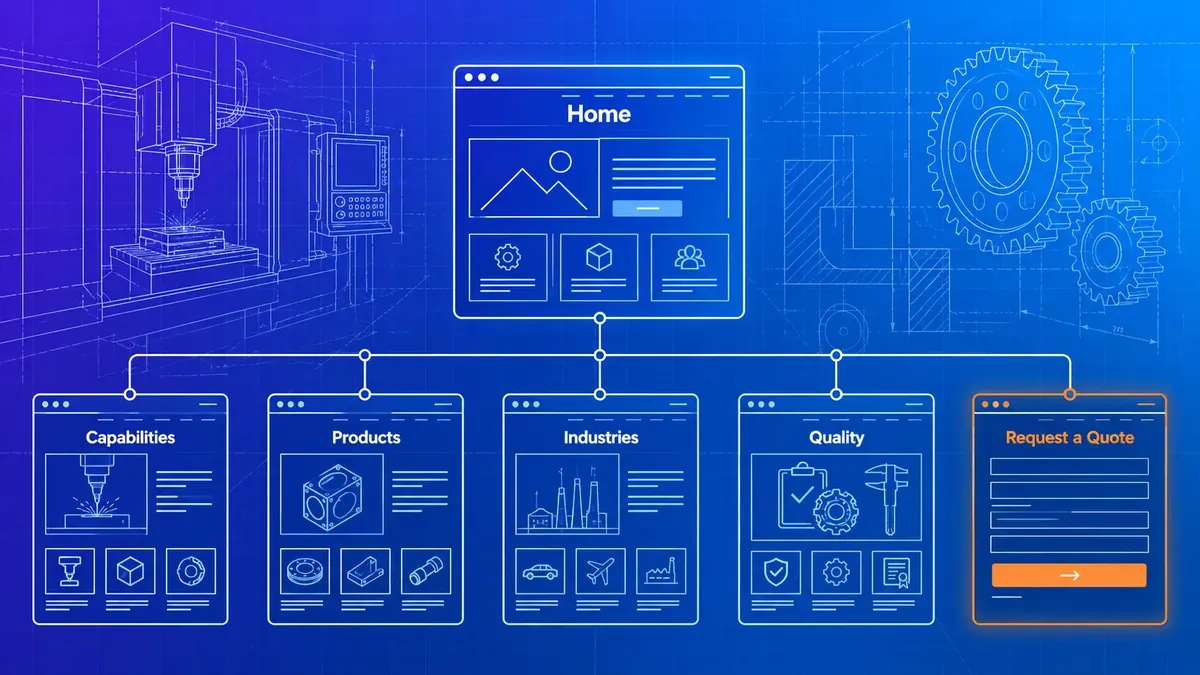
A typical factory website
Across India’s industrial belts, most factory websites look the same: a homepage, an About page, one Products page listing dozens of items, and a contact form. Meanwhile, buyers search for something far more specific:
Neither search has a page to land on.
Industrial SEO starts with website structure, not blog posts or backlinks. If your pages do not match how buyers search, extra content and links have very little to work with.
What is industrial SEO website structure?
It means organising pages so that each one answers a specific buyer search.
Instead of crowded, do-everything pages, you create separate pages for each product line, process, industry served and proof asset, connected by clear navigation and internal links. That helps three audiences at once:
Google
Understands what you make and which page matches which search.
Buyers
Find the capability they need within two clicks.
AI search tools
Can extract clear, factual information about your company.
How do industrial buyers search for suppliers?
Buyers search by product, process, industry, location, specification, problem and proof, and most of that research happens before they ever speak to a supplier.
67%
of B2B buyers prefer a rep-free buying experience
45%
of B2B buyers used AI during a recent purchase
Source: Gartner sales survey, March 2026
If your website does not answer their searches during that research phase, you may not make the shortlist at all.
| Search type | Example query | Page you need |
|---|---|---|
| Product | “hydraulic cylinder manufacturer” | Product page |
| Process | “5-axis CNC machining services” | Capability page |
| Industry | “precision components for EV motors” | Industry page |
| Location | “sheet metal fabrication Pune” | Location on key pages |
| Specification | “SS304 laser cutting 6 mm” | Specification table |
| Problem | “how to reduce casting defects” | Article or guide |
| Trust check | “ISO 9001 machining company” | Certifications page |
Which pages should a manufacturing website have?
Seven page types form the foundation of a manufacturing website that ranks and converts.
Home page
States what you make, for which industries and where.
“Precision CNC machined components for automotive and EV OEMs, Pune”
Capability pages
One per process: CNC turning, VMC machining, laser cutting, powder coating, assembly.
Product pages
One per product line, with specifications, materials, tolerances and applications.
Industry pages
One per industry you genuinely serve, such as automotive, agriculture equipment or pharma machinery.
Proof pages
Case studies, certifications, facility and machine lists, and client logos used with permission.
Resource pages
Articles and guides that answer buyer questions.
Conversion pages
An RFQ form with drawing upload, a contact page, and WhatsApp or call options.
Layers two to five are where buyers and Google spend their time. That is where enquiries usually come from.
How should you plan the sitemap?
Group pages by capability, product and industry, and keep every page within three clicks of the homepage.
Here is a sample structure for a CNC machining company:
One crowded site
- Home
- About Us
- Products (40 items on one page)
- Gallery
- Contact Us
Buyer-search sitemap
- /capabilities//cnc-turning/ · /vmc-machining/ · /5-axis-machining/
- /products//turned-components/ · /machined-housings/ · /precision-shafts/
- /industries//automotive/ · /electric-vehicles/ · /agriculture-equipment/
- /quality/ · /facility/ · /case-studies/
- /blog/ · /about/
- /request-a-quote/One click from every page
- Use lowercase words separated by hyphens
- Keep URLs short and descriptive
- Avoid dates or random IDs in product URLs
- Keep one topic per URL
These follow Google’s own URL structure guidelines. Then submit an XML sitemap in Google Search Console so Google can discover and understand the structure.
How do you map keywords to pages without confusing Google?
Assign one primary keyword to one page. When several pages chase the same search, they compete with each other and none ranks well.
List everything you sell
Every product, process and industry you serve.
Write the buyer’s phrases
The words buyers would type, including the city or industrial area if you sell regionally.
Check Google
Autocomplete and the “People also ask” box.
Assign one phrase to one page
Keep the map in a simple spreadsheet.
Use it where it counts
The page’s title tag, H1, URL and first paragraph.
| Page | Primary keyword | Secondary keywords |
|---|---|---|
| /capabilities/cnc-turning/ | CNC turning services Pune | CNC turned parts, precision turning |
| /industries/electric-vehicles/ | EV component manufacturer | machined parts for EV motors |
| /products/precision-shafts/ | precision shaft manufacturer | ground shafts, stepped shafts |
| /quality/ | ISO 9001 machining company | CMM inspection, quality process |
For a deeper look at finding these phrases, read the keywords your buyers actually type.
What should every product or capability page include?
A purchase engineer needs quick confirmation that you can make their part.
Illustrative example. Use your own real specifications.
- A clear H1 with the keyword
- A two- or three-sentence summary of what you make, the size range and key industries
- A specification table: materials, size range, tolerances, surface finish and batch sizes
- A machine list with make and model
- Applications and industries served, linked to industry pages
- Real photographs of parts and your shop floor
- Relevant certifications
- A short FAQ on MOQ, lead time and accepted drawing formats
- An RFQ form that accepts PDF, STEP or DWG drawings
How does internal linking support industrial SEO?
Internal links show Google how pages relate, and guide buyers towards an enquiry.
A simple hub-and-spoke model works well: industry pages link to the capability and product pages that serve that industry, and capability pages link back to the industries and case studies they relate to.
Does structure matter for AI search tools like ChatGPT?
Yes. AI search tools favour pages with clear, specific, factual statements they can quote.
“We offer a wide range of high-quality engineering products for various industries.”
“We machine SS304 and EN8 shafts from 10 mm to 150 mm diameter for tractor OEMs.”
- Open key pages with a direct summary of what you make and for whom
- Use question-style subheadings for common buyer questions
- Add short FAQ answers
- Use accurate structured data that matches visible content
- Keep company details consistent across your website, Google Business Profile, directories and LinkedIn
Industrial SEO and AI search optimisation now share the same foundation.
What are the most common structure mistakes?
The most common mistake is putting every product on one page. Every one of these can be fixed without rebuilding the whole website.
One crowded Products page
30 or more items with no individual pages, so nothing ranks on its own.
Catalogues only as PDFs
Buyers rarely download them and search engines read them less reliably.
No industry pages
Application-based searches are missed entirely.
A name, not a capability
The homepage headline states the company name instead of what you make.
No RFQ on product pages
Only one generic contact form at the end of the menu.
Orphan articles
Blog posts that never link to product or capability pages.
How can you restructure your website in 30 days?
Work one layer at a time, one week each.
Week 1: audit and map
List every product, process and industry, build a keyword map, and check Search Console for pages already earning impressions.
Week 2: capability and product pages
Start with your three highest-margin products or processes. Add specification tables, real photographs and RFQ forms.
Week 3: industry and proof pages
Create pages for your top three industries, and publish your machine list, certifications and at least one case study you have permission to share.
Week 4: connect and submit
Add internal links, update menus, set up 301 redirects for changed URLs, and submit the updated sitemap.
If you change old URLs, always set up 301 redirects, or you risk losing the rankings those pages already earned. After launch, track impressions, clicks and RFQs per page for at least 90 days.
Quick structure check
6 of 6 unticked. Your structure is leaving searches without a page to land on. Start with the week 1 audit above.
Summary
- Industrial SEO works best when your website mirrors how buyers search.
- Create separate pages for capabilities, products and industries, supported by proof pages.
- Assign one primary keyword per page and open each page with a specification-rich summary.
- Include RFQ forms that accept drawings, connect everything with hub-and-spoke internal links, and submit a clean XML sitemap.
- The same structure helps AI search tools understand and quote your company.
Frequently asked questions
What is industrial SEO?
Industrial SEO is search engine optimisation for manufacturers and industrial suppliers. It focuses on the technical, specification-based searches made by engineers and purchase teams, and aims for qualified RFQs rather than traffic volume.
How many pages should a manufacturing website have?
One page per major product line, process and industry served, plus proof and contact pages. A CNC shop with three processes, four product lines and three industries might need around 15 to 20 core pages before adding articles.
Should I upload my product catalogue as a PDF?
Keep the PDF as a download, but never as the only source of product information. Create web pages for each product line and offer the PDF as supporting material.
How long does it take a restructured website to rank?
Google usually recrawls restructured pages within weeks. Specific, location-based searches tend to move first; competitive national searches can take several months. Rankings are never guaranteed.
Do I need a separate page for every city I serve?
Only if you have genuinely different content for that location, such as a facility or service team. Copy-pasted city pages tend to be thin and can work against you.
Sagar Mamure is the Founder and CEO of Marketing Mantra, a Pune-based marketing, sales and branding consultancy for manufacturing SMEs. A mechanical engineer turned marketer, he helps factories turn their websites and LinkedIn into steady sources of RFQs. Connect on LinkedIn.