CRM and Sales4 min read
Manufacturing CRM Guide: How to Stop Losing Leads in WhatsApp Threads
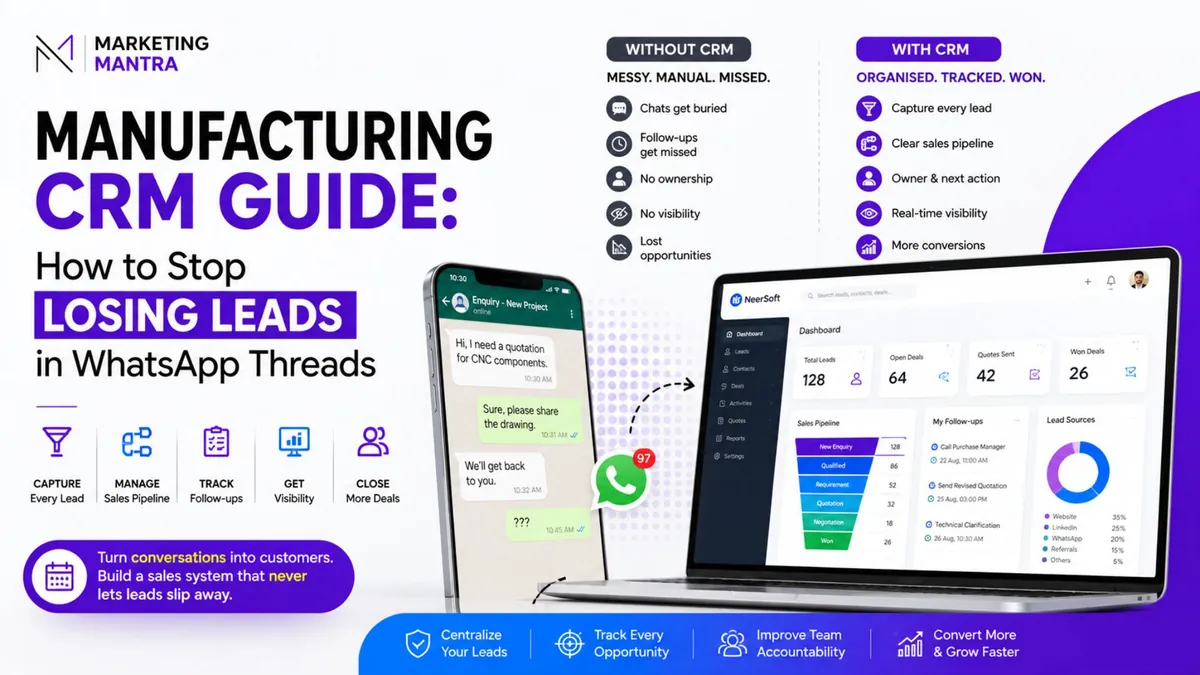
Your biggest sales problem may not be a lack of leads. It may be losing the leads you already have, somewhere between a WhatsApp thread and a quotation that went quiet.

Sagar MamureMechanical engineer turned marketer · Founder, Marketing Mantra
A familiar Tuesday
A buyer sends an enquiry on WhatsApp. Your salesperson replies, asks for the drawing and promises a quote. The quote goes out a few days later.
Then the thread scrolls up under fifty other conversations, and nobody follows up.
Your biggest sales problem may not be a lack of leads. It may be losing the leads you already have. That is a sales-management problem, not a messaging-app problem.
Why can’t WhatsApp be your CRM?
WhatsApp is excellent for communication but poor at sales management.
Ask yourself whether you can answer these questions in under a minute:
Can you answer these in under a minute?
6 of 6 unticked. The answers live in phones, inboxes and memory. You do not have a system yet, you have a hope that nothing slips.
What is a CRM?
A CRM keeps customer details, enquiries, quotations, follow-ups and notes in one place the company owns.
CRM stands for customer relationship management. Instead of living in individual employees’ heads and phones, the sales history lives in a system that stays with the business.
What are the seven CRM practices for manufacturers?
Capture every lead, give it an owner and a next action, track quotations, and review the pipeline every week.
Capture every lead
Bring enquiries from your website, Google, LinkedIn, email, WhatsApp, referrals, exhibitions and outreach into one system. A lead that is not recorded cannot be followed up or measured.
Create a clear sales pipeline
Define the stages an enquiry moves through.
Give every lead an owner
For each lead, you should see the owner, the stage, the value and the next action.
Never leave a lead without a next action
Every open lead needs a specific task with a date.
“Call purchase manager, Thursday 22 August”, not “follow up soon”
Track quotations properly
Date, value, customer, salesperson, next follow-up, stage and final outcome. This is often where the most money is quietly lost.
Build customer history at company level
When records live in a salesperson’s phone, a resignation can take relationships with it.
Review the pipeline weekly
New enquiries, high-value deals, overdue follow-ups, quotations sent, stuck opportunities, and deals won or lost and why.
How should you choose a CRM?
Choose the CRM your team will actually use every day, not the one with the longest feature list.
Options such as Zoho, HubSpot and Odoo all work for manufacturers. Growing teams that want to move from scattered lead handling to one central process can also look at NeerSoft CRM, which covers lead tracking, follow-up management, sales pipelines, team collaboration, reporting and integrations.
Whichever platform you pick, it must match your actual sales process. Base the decision on:
Your sales process
How your team actually sells today.
Adoption
How easily your team will use it every day.
Integrations
Your website form, email and other enquiry sources.
Reporting
The reports management needs each week.
A complex CRM nobody updates will perform worse than a simple one your team uses every day.
How do you implement a CRM in four weeks?
Map the process first, then configure, import and train.
Week 1
Map your current sales process from enquiry to order.
Week 2
Configure stages, fields, owners and reports in the CRM.
Week 3
Import active leads and open quotations from spreadsheets, inboxes and phones.
Week 4
Train the team on one rule.
“If a lead is not in the CRM, it is not in the pipeline.”
Want to understand where enquiries should come from in the first place? Read how manufacturing companies can generate inbound leads online.
Summary
- Every lead is captured.
- Every lead has an owner and a dated next action.
- Every quotation is tracked through to won or lost.
- Management can see the pipeline every week.
- WhatsApp stays a communication channel. Your CRM stays the system of record.
Frequently asked questions
Can WhatsApp be integrated with a CRM?
Often, yes, depending on the CRM. Map your workflow before you choose an integration, so WhatsApp conversations feed the system of record rather than replacing it.
Do small manufacturers need a CRM?
If you handle multiple enquiries, more than one salesperson, or quotations that need follow-up, a simple CRM is usually worth it.
Is Excel enough?
Excel can work at the very start, but it becomes hard to manage as lead volume, team size and sales complexity grow.
What is the biggest CRM mistake?
Buying software before defining your sales process. Decide how you sell first, then configure the tool to match.
Sagar Mamure is the Founder and CEO of Marketing Mantra, a Pune-based marketing, sales and branding consultancy for manufacturing SMEs. A mechanical engineer turned marketer, he helps factories turn their websites and LinkedIn into steady sources of RFQs. Connect on LinkedIn.