Websites5 min read
Your Industrial Marketing Website Is a Salesperson. Has Anyone Trained It?
Your website meets every buyer who searches for your product at 11 pm, and it never takes leave. But most manufacturers have never trained it to sell.

Sagar MamureMechanical engineer turned marketer · Founder, Marketing Mantra
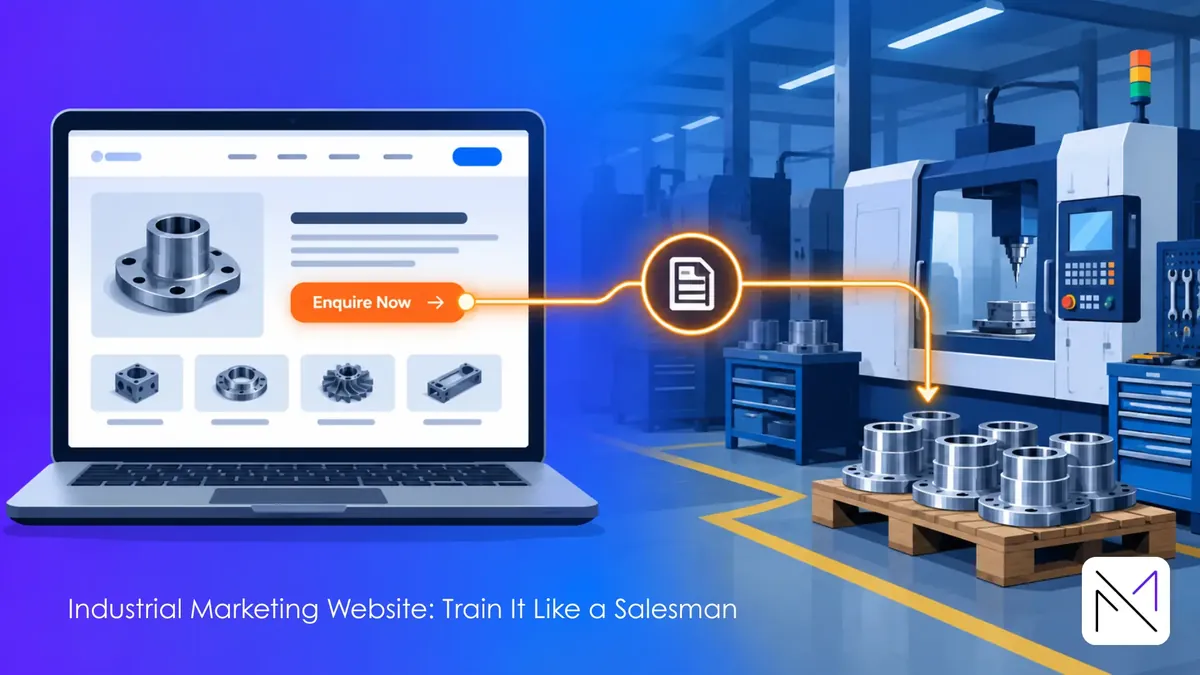
Your website is your most active salesperson. It works around the clock, it meets every buyer who searches for your product late at night, and it never takes leave. Yet most manufacturers have never trained it.
What usually happens
A buyer searches for a supplier and lands on your homepage. They see this:
No machine list, no size range, no capacity. They leave after a few seconds.
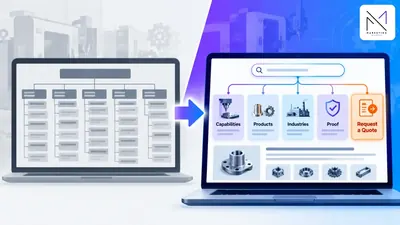
A trained industrial marketing website behaves differently. It qualifies visitors, answers technical questions, demonstrates capability and offers a clear next step.
Why does your website behave like an untrained salesperson?
Because nobody gave it a script, a qualifying question or a closing line.
Think about your best salesperson at an exhibition stall. They follow four steps, in this order:
Read the badge
Who is this visitor, and which company are they from?
Ask about the application
What are they trying to make, and to what specification?
Show the right products
Only the capabilities that fit their requirement.
Ask for the drawing
Move straight to a quotation.
Most manufacturing homepages do none of this. They mirror the printed brochure: a generic statement about commitment to quality, followed by the standard menu. A buyer looking for a CNC job shop sees a facility photo but cannot find the machine list, the size range or the monthly capacity, which are exactly what they came to check.
What does a buyer do before contacting you?
Much more than most owners assume. Buyers research, compare and discuss internally before they call anyone.
67%
of B2B buyers prefer a rep-free buying experience
45%
of B2B buyers used AI during a recent purchase
Source: Gartner sales survey, March 2026
That AI research matters. Specifications buried in PDFs or images are much harder for AI tools and search engines to read. If your capability data is only in a scanned catalogue, it may effectively be invisible.
What does a trained website do differently?
It turns your existing shop-floor reality into answers a buyer can check in seconds.
| Element | Untrained website | Trained website |
|---|---|---|
| Homepage headline | “Precision machined components for hydraulic OEMs, 5-micron tolerance” | |
| Product page | Material grades, size range, tolerance, finish, MOQ, lead time | |
| Capability | Machine list with make, model, bed size and count | |
| Proof | Named application, part photo, outcome, certificate copies | |
| Call to action | Send your drawing for a quote | |
| Enquiry handling | CRM, acknowledgement, owner |
None of this needs clever copywriting. It is your existing shop-floor reality, properly documented.
How do you train your website in seven steps?
Start with the headline and capability data, then add proof, one clear action and a CRM behind the form.
Rewrite the headline for the buyer’s job
Name the component, the industry and the capability. Move the vision statement elsewhere.
Publish your capability data as text
Machine specifications, sizes, tolerances, materials, monthly capacity and certifications, in HTML tables rather than images.
Give every application its own page
Buyers search by application, such as automotive, hydraulics or pharma equipment, not by company name.
Add proof that a technical person believes
Part photographs, the technical challenge, tolerances held and the type of customer, anonymised where needed.
Replace “Contact Us” with one specific action
“Upload your drawing” or “Request a sample” matches how sourcing actually begins.
Answer the ten questions sales hears on every call
Lead time, MOQ, export capability, payment terms, tooling cost, inspection reports.
Connect the form to a CRM
Even a free tier of Zoho or HubSpot stops enquiries disappearing into a shared inbox.
Our manufacturing CRM guide explains how to set up step seven.
How do you make the website visible in AI search?
Write the facts in plain text and structure them so a machine can lift them out.
Question-style headings
Use the questions buyers actually ask as your subheadings.
Answer first
Put the direct answer in the first sentence under each heading.
Specifications in tables
Grades, sizes and tolerances as text, not images.
Consistent details
The same company facts across your website, Google Business Profile and directories.
Also check that your robots.txt does not accidentally block the AI crawlers you want to be found by, and only use FAQ structured data where the questions are visible on the page.
How do you measure whether your website is selling?
You do not need dozens of statistics. Four measures are enough to start.
| Measure | What it tells you | How to use it |
|---|---|---|
| Enquiry conversion rate | Is the site turning visits into enquiries? | Set your own baseline in month one, then improve it |
| Enquiry quality | Are the right buyers arriving? | Check what share matches your ideal customer |
| Response time | Are warm leads going cold? | Aim to reply within hours, not days |
| Top landing pages | Which pages produce enquiries? | Application pages should beat the homepage |
Improve one measure each quarter rather than redesigning the whole site every few years.
How long does this take?
Retraining an existing website typically takes a few weeks; a new build takes longer.
The biggest factor is how quickly your team can provide real technical content, specifications and photographs. Assigning one internal owner speeds things up considerably. Budget for content and photography, not just design.
Is your website trained?
5 of 5 unticked. Your website is still an untrained salesperson. Start with the headline and capability data.
Summary
- Your website handles most of the buyer’s journey without your sales team in the room.
- Most manufacturing sites describe the company instead of answering technical questions.
- Trained sites publish capability data as text, give applications their own pages, show specific proof and ask for one clear action.
- Fix content and enquiry handling before you consider a redesign.
Frequently asked questions
Why do manufacturing websites get traffic but no enquiries?
Because the pages answer the company’s questions instead of the buyer’s. Visitors want tolerance, material, capacity and lead time quickly. Generic statements and stock photographs send them to a competitor who shows those details.
Should specifications go in a PDF or on the page?
On the page, as text and tables, with the PDF offered as a supplementary download. Search engines and AI tools read HTML text far more easily than scanned PDFs and images.
Do I need a new website or just better content?
Usually better content. If the site loads quickly, works on mobile and is easy to edit, retrain it before you rebuild it.
Sagar Mamure is the Founder and CEO of Marketing Mantra, a Pune-based marketing, sales and branding consultancy for manufacturing SMEs. A mechanical engineer turned marketer, he helps factories turn their websites and LinkedIn into steady sources of RFQs. Connect on LinkedIn.