Marketing Strategy5 min read
Why Most Businesses Fail Before They Even Start (And How to Validate Your Idea Properly)
Most businesses do not fail for lack of passion or money. They fail because nobody wanted what they built. Here is how to validate first.

Sagar MamureMechanical engineer turned marketer · Founder, Marketing Mantra
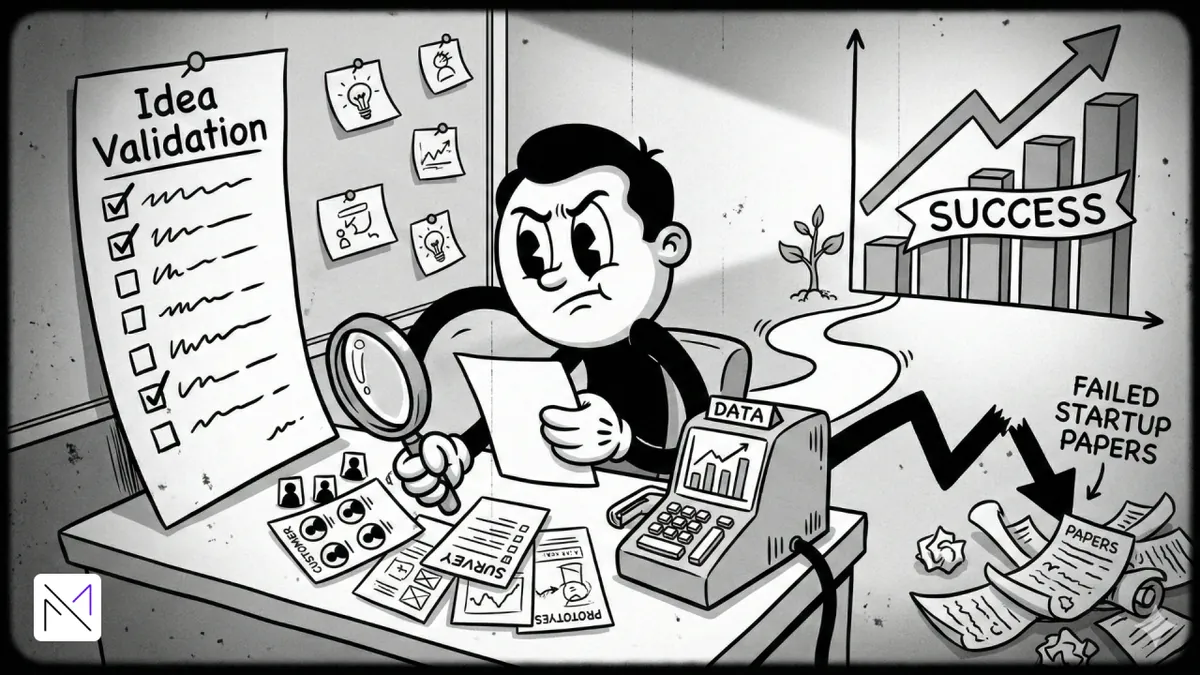
Every year, thousands of businesses are launched. And most of them die quietly.
Not because the founders lacked passion. Not because they didn't work hard. Not even because they ran out of money. They fail because they built something nobody actually wanted.
The brutal truth of entrepreneurship: an idea is worthless until the market validates it.
Yet many founders skip validation completely. They spend months building a product, designing a logo, launching a website and setting up social media, all before confirming whether anyone will actually pay. This article breaks down the process to validate a business idea before investing serious time or money.
Check founder–market fit first
Before analysing the market, analyse yourself.
One of the strongest predictors of startup success is founder–market fit: the alignment between the founder's experience and the problem they are solving.
Ask yourself
4 of 4 unticked. Weak founder–market fit. Consider a problem you understand more deeply.
Many businesses fail because founders chase trends instead of solving problems they genuinely understand. A strong business usually sits at the intersection of three things:
Passion
You care enough to keep going for years.
Skill
You can actually solve the problem.
Profit potential
People will pay enough to sustain it.
If any one of these is missing, the business becomes unstable.
Stop thinking about ideas, start thinking about problems
Most founders ask, “What business should I start?” Wrong question.
“What business should I start?”
“What painful problem can I solve?”
Customers don't buy products. They hire solutions to get something done. This is the Jobs-To-Be-Done framework: people choose products based on the task they want to accomplish.
| Customer problem | → | Business opportunity |
|---|---|---|
| Grocery shopping is time-consuming | → | Meal delivery services |
| Taxi booking is inconvenient | → | Ride-sharing platforms |
| Legal paperwork is slow | → | Digital notarisation |
Great businesses improve one of four things:
Speed
Get it done faster.
Cost
Get it done cheaper.
Convenience
Get it done more easily.
Experience
Make it feel better.
You don't need a revolutionary idea. You need a better way to solve an existing problem.
Do market research without spending money
Most people think market research requires expensive reports. It doesn't. You can validate demand with free tools.
Google Trends
Check if interest in your problem is growing or declining.
Reddit and Quora
People complain about real problems there. Look for frustrations, alternatives and workarounds.
AnswerThePublic
Shows real questions people search online.
Keyword tools
Check if people actively search for solutions. High demand often signals real pain.
Talk to customers, and ask the right questions
Most founders make a massive mistake: they ask, “Would you use this product?” Everyone says yes, because people want to be polite.
That's why experienced founders follow The Mom Test: instead of asking about your idea, ask about their behaviour.
Questions to avoid
- “Would you use this?”
- “Do you like this idea?”
Better questions
- “How are you currently solving this problem?”
- “When was the last time you faced it?”
- “How much time or money do you spend fixing it?”
If someone has never tried to solve the problem, they probably won't pay for your solution.
Do the “napkin math”
Before building anything, test whether the business economics even make sense.
If the resulting profit is tiny, the idea is not a business. It's a hobby. This quick financial sanity check saves founders months of wasted effort.
Validate the idea without building the product
You don't need a finished product to test demand. Use fake door validation.
Create a simple landing page
Describe the product and add a “Pre-order”, “Join waitlist” or “Get early access” button.
Drive traffic
Social media, niche communities, Reddit and LinkedIn posts.
Observe behaviour
If nobody clicks the button, the market is telling you something important.
Real validation happens when someone:
- Gives their email
- Joins the waitlist
- Tries to pay
That's real demand.
Build a simple prototype (for product businesses)
Many founders overbuild their first version. The goal of a Minimum Viable Product is to learn the most about customers with the least effort.
Concierge MVP
You deliver the service manually, for example personally sourcing products for early customers.
Wizard of Oz MVP
The product appears automated, but humans run the back end.
Piecemeal MVP
Use existing tools instead of building technology: Webflow or Carrd for the website, Airtable for a database, Zapier for automation, Stripe for payments.
This lets founders test ideas quickly without expensive development costs.
Getting the first client (for service businesses)
Service businesses don't need an MVP. They need conversations: Minimum Viable Conversations.
Start with a very specific niche:
“We do digital marketing.”
“We help manufacturing companies generate leads using SEO.”
Then reach out directly. Cold outreach works when it follows a clear structure:
Short, personalised emails outperform long sales pitches.
The real Marketing Mantra
Marketing cannot fix a bad idea. Real success comes from this sequence:
Understand the problem
Validate the demand
Test the economics
Prototype quickly
Talk to real customers
Only then should you scale marketing. Because marketing doesn't create demand. It amplifies existing demand.
Final thought
Entrepreneurship isn't about building products. It's about testing assumptions. The founders who win are not the ones with the best ideas. They are the ones who validate, learn and adapt fastest.
Before you start your next business, ask yourself one brutal question: has the market actually asked for this? Or are you just hoping it will?
Key takeaways
- Most businesses fail because they build something nobody wants.
- Check founder–market fit, then focus on a painful problem, not an idea.
- Research for free, and ask customers about behaviour, not opinions.
- Run the napkin math and test demand before you build.
- Marketing amplifies demand; it cannot create it.
Sagar Mamure is the Founder and CEO of Marketing Mantra, a Pune-based marketing, sales and branding consultancy for manufacturing SMEs. A mechanical engineer turned marketer, he helps factories turn their websites and LinkedIn into steady sources of RFQs. Connect on LinkedIn.
Originally published in the Marketing Mantra newsletter on LinkedIn.