Marketing Strategy4 min read
The 2025 Mantra: Stop Competing on Cost — Start Winning on Value
Be reliable, be cheap: the old rulebook for Indian manufacturers is now holding growth back. How to shift from competing on cost to winning on value.

Sagar MamureMechanical engineer turned marketer · Founder, Marketing Mantra
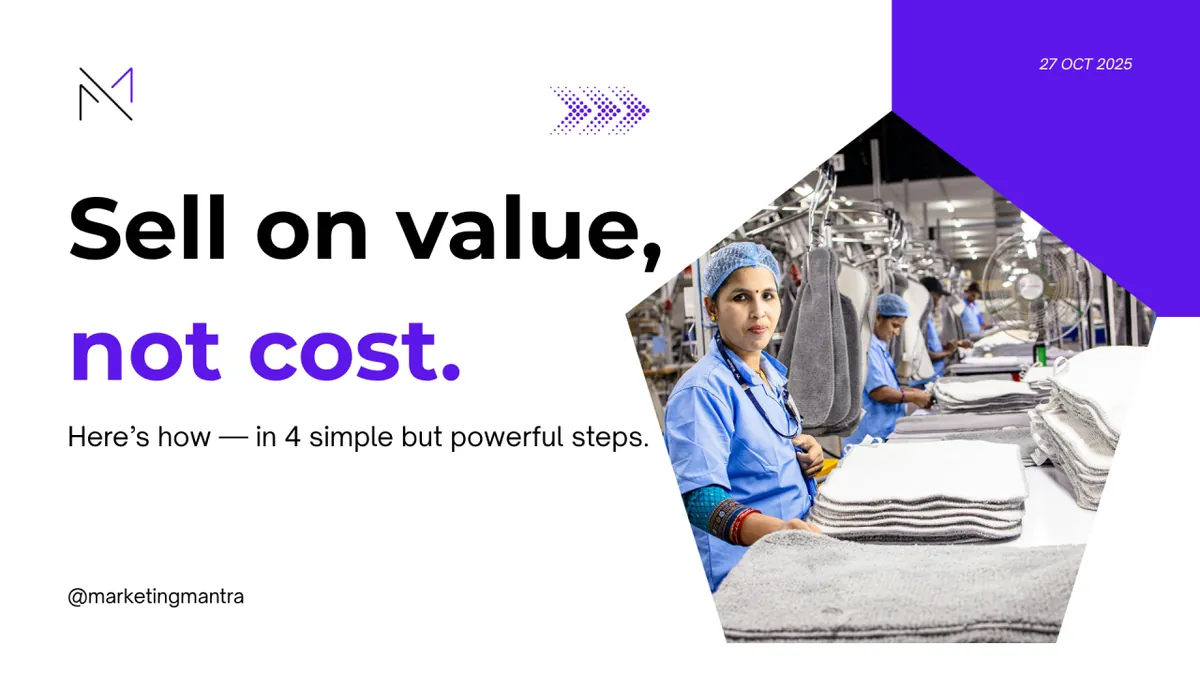
For years, most Indian manufacturers followed the same rulebook: be reliable, be cheap. That formula worked in the past. But in 2025, it's killing growth.
What is the reality check?
India's manufacturing sector looks strong on paper, but the ground reality for most small manufacturers is still tough.
Exports are up. The government is pushing new MSME-friendly policies. But:
- Payments get delayed for months
- Banks still hesitate to lend
- Margins are thinner than ever
That's because most manufacturers are stuck in cost-based competition, trying to survive by being cheaper than the next guy. That model doesn't work any more. The winners will be those who sell on value, not cost.
It's time to shift from “cheapest supplier” to “most trusted partner”. Here's how, in four pillars.
Pillar 1: Fix your cash flow first
If your cash is stuck in unpaid invoices, you can't grow, period.
Most MSMEs wait 30 to 120 days to get paid after delivery. Meanwhile, raw material costs rise, and you can't take on new orders because your money is still with your buyers.
The solution: invoice factoring through TReDS platforms. Think of it as selling your unpaid invoices to a financial institution. You get the cash almost immediately, at a small discount, and the buyer pays the financier later.
It's not a loan
The financier checks your buyer's credit, not yours.
Instant liquidity
You can start the next order right away.
It works for exports
Export factoring protects you from foreign buyer defaults and delays.
In short, factoring turns your receivables into working capital. Stop waiting. Start reinvesting.
Pillar 2: Stop competing on price; compete on proof
If your only selling point is “lowest price”, you'll always lose to someone cheaper. Instead, prove why you're worth more.
That proof can come from ZED Certification (Zero Defect, Zero Effect), a government-backed quality certification that shows your processes are world-class and sustainable.
- Subsidy support on the certification cost is available (check the current scheme rules)
- It becomes your sales weapon: proof that your product delivers value and reliability
- Buyers, especially global clients, trust certified suppliers more
So, change your sales pitch:
“We offer good quality at a low price.”
“We're ZED Certified: zero defects, zero rework, and proven reliability.”
Bonus tip: look at the Credit-Linked Capital Subsidy Scheme (CLCSS) for subsidies on new machinery that helps you meet ZED standards. Scheme rules and percentages change, so confirm the current terms before you apply.
Pillar 3: Build your digital foundation, then use AI to sell smarter
Your customers are online. If your business isn't, you're invisible. But don't jump into “digital transformation” blindly. Start in order.
Strengthen your foundation
Before you use fancy tools, fix your internal data and systems. Adopt basic Industry 4.0 tools, such as cloud computing, IoT and digital monitoring, to track production, defects and performance in real time. Government schemes such as CLCSS and LEAN can support upgrades.
Use AI for smart B2B sales
Instead of cold calls and generic emails, use AI tools that identify high-potential buyers from real-time data and create personalised messages and proposals for each client.
If building this in-house feels overwhelming, partner with a B2B lead generation agency that specialises in your industry. They already have the tools and expertise, so you can focus on production and delivery.
Pillar 4: Dominate the right sales channels, in India and beyond
Even the best products won't sell if you're invisible in the right places.
Domestic: IndiaMART
One of India's largest B2B marketplaces. Don't just list products: optimise your profile, reply fast, and treat it as a main sales funnel.
Domestic: Tata Nexarc and Flipkart Wholesale
Verified suppliers, raw material sourcing and logistics; selling directly to small retailers and kirana stores.
Export: diversify markets
Don't depend on one destination. GCC countries, Africa and the UK are actively seeking Indian suppliers.
Export: build trust
Use export factoring to secure payments, certification to justify premium pricing, and global platforms like TradeIndia to reach buyers.
What is your 12-month action plan?
Make it practical. Here's your roadmap.
Fix cash flow
Now.
Get certified
This quarter.
Digitise your operations
This year.
Expand smartly
Ongoing.
Value-not-cost check
5 of 5 unticked. You are probably still competing on cost. Start with cash flow and proof.
Final thought
The future of Indian manufacturing isn't about being cheap. It's about being credible, digital and value-driven.
The MSMEs that adapt now will dominate the next decade. Those that don't will keep fighting over shrinking margins. It's time to stop surviving and start scaling, by shifting from cost to value.
Key takeaways
- Competing only on price is a losing game for small manufacturers.
- Fix cash flow first; factoring turns receivables into working capital.
- Compete on proof, such as quality certification, not on discounts.
- Build your digital foundation before adding AI-led sales.
- Be visible on the right channels, in India and abroad.
Sagar Mamure is the Founder and CEO of Marketing Mantra, a Pune-based marketing, sales and branding consultancy for manufacturing SMEs. A mechanical engineer turned marketer, he helps factories turn their websites and LinkedIn into steady sources of RFQs. Connect on LinkedIn.
Originally published in the Marketing Mantra newsletter on LinkedIn.