Marketing Strategy3 min read
10 Red Flags That Are Quietly Killing Small Manufacturing Companies
Most factories do not shut down because of competition. They shut down because of internal blindness. Ten red flags to check today.

Sagar MamureMechanical engineer turned marketer · Founder, Marketing Mantra
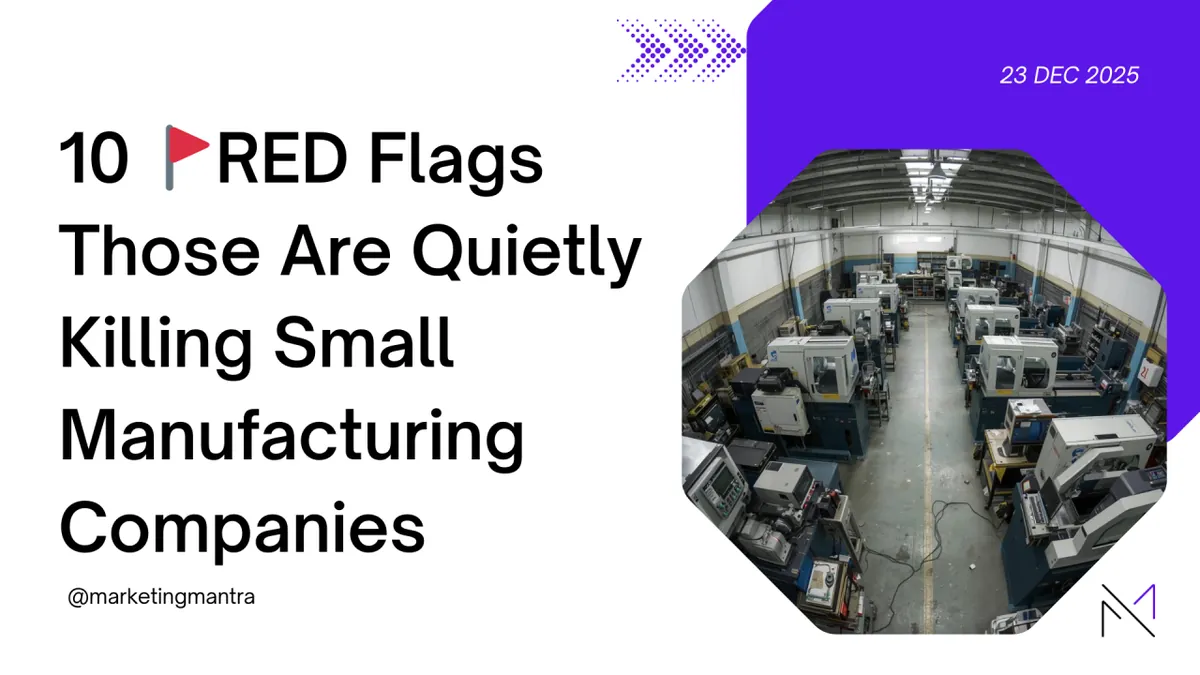
Most factories don't shut down because of competition. They shut down because of internal blindness.
If even 3–4 of these feel familiar, you don't have a scale problem; you have a leadership problem. Tick the ones that apply to your company as you read.
Which red flags do you recognise?
0 of 10 ticked. Few red flags so far. Keep reading, and be honest with yourself.
The nine everyday red flags
These are the habits that quietly slow a factory down.
1. Ignoring customer losses
When orders drop, you blame the market, GST, China or salespeople. Reality: customers leave because of quality issues, delays, poor follow-up or zero relationship management. If you're not personally reviewing why customers stop ordering, you're choosing ignorance.
2. Owner micromanaging everything
You approve every purchase, every dispatch, every quotation. That's not control; that's bottlenecking growth. Your team stops thinking, decisions slow, errors rise, and you burn out.
3. Wrong people in key roles
You keep a supervisor or accountant because “he's been with me for 10 years”. Loyalty without capability is dangerous. Manufacturing today needs data, planning and systems, not just experience.
4. No second line of leadership
If production, sales or accounts stop the moment you're unavailable, you don't own a business; you work in a high-stress job. A factory that can't run 30 days without the owner is fragile by design.
5. Avoiding hard conversations
Everyone knows who's underperforming, except the owner, who avoids conflict. Silence tells the shop floor that standards don't matter. Good people leave. Bad habits stay.
6. No clear business strategy
Ask three managers where the company is headed. Three different answers means motion without direction.
7. Living in WhatsApp and firefighting mode
Urgent calls, breakdowns and vendor follow-ups leave zero time for systems, planning, pricing or improvement. Firefighting feels productive. It's actually slow decay.
8. Meetings without decisions
Meetings that end with “let's see” or “we'll discuss later” waste manpower. Every meeting must end with clear actions, owners and deadlines, or don't have the meeting.
9. Trying to do everything
Too many product variants, industries and custom jobs. You say yes to everything and master nothing. Focus beats flexibility in manufacturing.
The most dangerous red flag: ignoring financial management
This one kills companies quietly, because the factory can look busy while cash disappears.
- No monthly P&L
- No cash-flow tracking
- No product-wise profitability
- No real costing, only “gut feel”
- The balance sheet is checked once a year by the CA
If you don't know which products make money, where cash is stuck, and how much working capital you actually need, you are running blind, no matter how busy the factory looks.
Busy ≠ profitable. Turnover ≠ cash. Experience ≠ control.
Final reality check
Most small manufacturing businesses don't need more machines, more loans or more hustle.
What you don't need
- More machines
- More loans
- More hustle
What you need
- Better leadership
- Financial visibility
- Systems that reduce dependence on the owner
If this post made you uncomfortable, good. That discomfort is cheaper than bankruptcy. Let's fix the systems, not just chase the next order, because growth without structure is just chaos with turnover.
Key takeaways
- Most factories fail from internal blindness, not competition.
- Owner micromanagement and no second line of leadership make a business fragile.
- Meetings need actions, owners and deadlines.
- Focus beats saying yes to everything.
- Without financial visibility, a busy factory can still be losing money.
Sagar Mamure is the Founder and CEO of Marketing Mantra, a Pune-based marketing, sales and branding consultancy for manufacturing SMEs. A mechanical engineer turned marketer, he helps factories turn their websites and LinkedIn into steady sources of RFQs. Connect on LinkedIn.
Originally published in the Marketing Mantra newsletter on LinkedIn.