Marketing Strategy7 min read
How Manufacturers Can Create Marketing Content That Sells Business Value, Not Just Specs
Most manufacturing marketing lists specifications. Buyers buy outcomes. Here is how to turn specs into business value your buyers care about.

Sagar MamureMechanical engineer turned marketer · Founder, Marketing Mantra
Walk into almost any manufacturing facility in India, and you'll meet someone who can talk for hours about the grade of steel they use, the tolerance of their machinery, or the automation running their production line.
Now look at their website. Their brochure. Their LinkedIn page. It's the same thing, a list of technical specifications.
Here's the hard truth no one in your industry will say out loud: your buyers don't purchase your specs. They purchase the business outcome that those specs create.
While your engineering team is proud of “dual-spindle CNC capability”, the CFO signing the cheque has one question: how does this help us scale, reduce costs, or stay ahead of our competitors?
If your marketing reads like an operating manual, your sales team will always be stuck competing on price. This guide shows you how to shift from spec-heavy content to value-driven marketing that generates real industrial leads.
Why is specs-first marketing costing you qualified leads?
Technical specifications are not the problem. The problem is leading with them.
This is one of the most common and most expensive marketing mistakes Indian manufacturers make. When your homepage says “16-axis CNC machining centre with ±0.002 mm precision”, you are speaking to the visitors who already know exactly what they need and are comparing prices. You have lost the plant heads, the CEOs and the procurement managers who are searching for a solution to a business problem they don't yet know how to name.
Spec-led marketing creates three compounding problems:
It attracts the wrong conversations
Buyers who evaluate you purely on specs will also evaluate your competitor on specs. The conversation collapses into price.
It delays decisions
Without understanding the business outcome, procurement committees can't build an internal business case to justify the purchase.
It commoditises your expertise
Years of engineering experience become invisible when your marketing doesn't translate what that experience does for a buyer.
The fix is simpler than most manufacturers expect.
What is the “So What?” test?
Before publishing any piece of marketing content, run every specification through one question: so what does this mean for the business owner reading this?
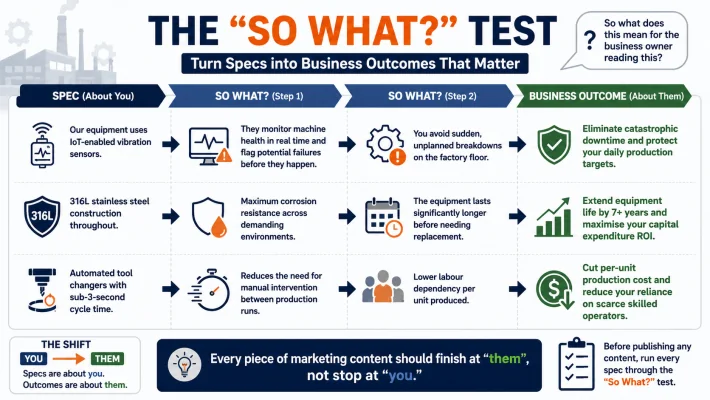
Keep asking it until you reach a business outcome. A LinkedIn post, a brochure, a product page, a case study: every one gets the same test. Here's how it works in practice:
Notice the pattern. The spec is about you. The business outcome is about them. Every piece of marketing content should finish at “them”, not stop at “you”.
How do you build a feature-to-value translation matrix?
Map your three most important specifications to their operational benefit and the business value they create, before you create any marketing material.
| Technical specification | Operational benefit | Business value |
|---|---|---|
| 316L stainless steel build | Maximum corrosion resistance | Extends equipment life by 7+ years, maximising capital ROI |
| Automated tool changers | Tooling swap in under 3 seconds | Reduces manual labour dependency, cuts per-unit cost |
| Modular plug-and-play design | Simplified installation and maintenance | Up and running in 48 hours, minimising installation downtime |
| IoT-enabled vibration sensors | Predictive fault detection | Eliminates unplanned shutdowns, protects production targets |
| Energy-efficient servo motors | 35% lower power draw vs. conventional motors | Reduces electricity costs, improves per-unit margin |
The figures in this matrix are illustrative. Use the numbers you can prove for your own equipment.
Once this matrix exists, your marketing team, your sales team and your website copywriter are all speaking the same language, and it's the language your buyers actually care about.
How should you rewrite your manufacturing case studies?
Lead with the result, open with the pain, and move specifications to the bottom.
Most B2B case studies from Indian manufacturers follow the same template: “We supplied Model X to Company Y.” That structure buries the most important information and loses the decision-maker before page two.
Lead with the financial or operational result in your headline
The second headline below makes the CFO stop scrolling. The first one doesn't.
Open with the pain, not the product
How much was the downtime costing them per day? What was the cost of their labour dependency? What happened to their delivery schedule when a machine failed? Make the pain real and specific, because that's what your next prospect is experiencing right now.
Move specifications to the bottom
Your technical data sheet belongs in an appendix for the engineer validating a decision. The business case, ROI, payback period and operational improvement belong at the top for the person approving the budget.
“Case Study: XYZ Logistics Automates Assembly Line”
“How an Automotive Component Maker Cut Assembly Costs by 32% Without Adding Headcount” (an example headline)
How do you speak to the entire buying committee?
In industrial B2B sales in India, you are rarely selling to one person. Most larger purchases involve a buying committee, and each member evaluates you through a different lens.
Plant manager or engineer
Wants to know if it works, how it integrates, how easy it is to maintain, and the specifications. Give them data sheets, CAD files and installation documentation.
Procurement head or CFO
Wants the total cost of ownership and the payback period. Give them ROI calculators, cost-benefit comparisons and energy-saving breakdowns.
CEO or managing director
Wants to know if this fits their growth plan or gives them an edge. Give them high-level industry case studies and strategic insights.
Most manufacturing companies create content for only one of these three people, usually the engineer. Your marketing should work for all three, because the engineer rarely makes the final call.
Which four marketing channels are manufacturers under-using?
Once your value-led messaging is in place, distribute it where your buyers are actually looking.
SEO-optimised website pages
Buyers searching “precision CNC machining for automotive OEMs” are ready to send an RFQ. Every product page needs a business outcome in the headline, a paragraph for the decision-maker, and a keyword that matches search intent.
LinkedIn for decision-makers
Founder posts, case study carousels and value-led thought leadership build the trust that generates inbound RFQs without cold calling.
AI search visibility (GEO)
Buyers increasingly use ChatGPT, Gemini and Perplexity to shortlist suppliers. If you don't appear, you lose opportunities you don't know exist.
Email and WhatsApp follow-up
Most leads are lost in the follow-up, not the first contact. A structured, CRM-backed follow-up sequence recovers leads that would otherwise go cold.
What does this look like in practice?
A fabrication company in Pune came to us with a common problem: a strong engineering team, a solid client base built on referrals, and almost zero digital presence.
Their website had not been updated in four years, and their only active channel was a WhatsApp group for existing customers. We rebuilt their marketing approach in three stages:
Messaging
We created a feature-to-value translation matrix for their five core product lines and rewrote their website copy to lead with business outcomes instead of specifications.
SEO + LinkedIn
We optimised their website for the search terms their buyers were actually using, and launched a LinkedIn presence for the founder focused on practical insights for plant managers and procurement heads.
CRM + follow-up
We implemented a simple Zoho CRM to capture and track every inbound enquiry, with an automated follow-up sequence for leads that didn't respond within 48 hours.
Within eight months, they were generating 9–12 qualified inbound enquiries per month, without spending on paid advertising. The product hadn't changed. The engineering hadn't changed. The marketing had.
Is your content selling specs or value?
5 of 5 unticked. Your content is probably selling specs. Start with the “So What?” test on your homepage.
The bottom line for Indian manufacturers
You don't need to remove your technical specifications. They are necessary for validation at the final stage of a sale. But if you lead with them, you are a commodity. Lead with business value, and you become a strategic partner.
Key takeaways
- Buyers purchase business outcomes, not specifications.
- Run every spec through the “So What?” test until you reach an outcome.
- Build a feature-to-value matrix so marketing and sales speak the same language.
- Write for the whole buying committee: engineer, finance and leadership.
- Distribute value-led content through SEO, LinkedIn, AI search and follow-up.
Sagar Mamure is the Founder and CEO of Marketing Mantra, a Pune-based marketing, sales and branding consultancy for manufacturing SMEs. A mechanical engineer turned marketer, he helps factories turn their websites and LinkedIn into steady sources of RFQs. Connect on LinkedIn.
Originally published in the Marketing Mantra newsletter on LinkedIn.