Marketing Strategy3 min read
How AI is Changing the Future of Digital Marketing
AI now writes ad copy, personalises content and predicts who will buy. How artificial intelligence is reshaping digital marketing.

Sagar MamureMechanical engineer turned marketer · Founder, Marketing Mantra
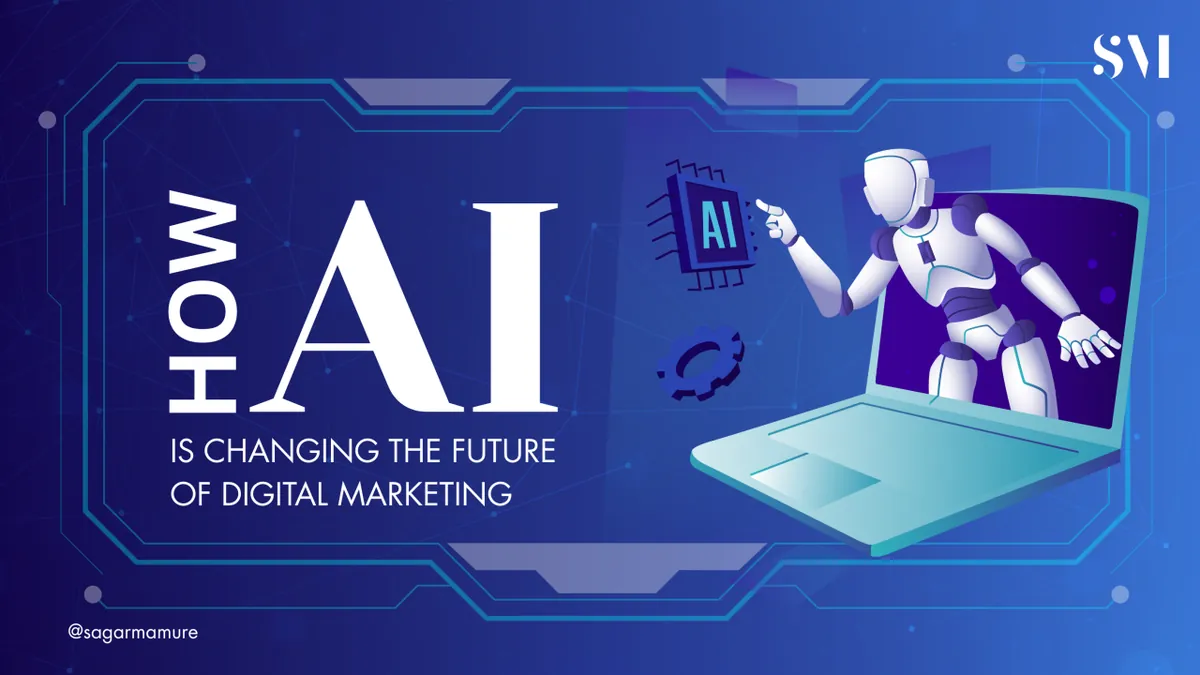
The digital marketing world is evolving at lightning speed, and artificial intelligence is right at the centre of that transformation.
What was once futuristic is now everyday reality: AI writes ad copy, personalises content, automates customer support, and even predicts who is likely to convert next. Having worked hands-on in digital marketing, I've seen how AI is reshaping everything, from the tools we use to the strategies that drive results.
What is AI in digital marketing?
AI in marketing means technologies that simulate human intelligence to automate decisions, analyse data and generate content in real time.
It goes beyond basic automation. Unlike rule-based automation, AI adapts, and that adaptability is what's changing the way we market.
Predict behaviour
Anticipate what customers are likely to do next.
Analyse data instantly
Make sense of large volumes of data in real time.
Personalise messages
Create highly personalised marketing at scale.
Learn and improve
Get better from every user interaction.
Where is AI making the biggest impact?
AI is changing insight, content, conversation, advertising and search.
Customer insights and predictive analytics
AI predicts buying behaviour and identifies high-value customers from real-time data, helping marketers prioritise leads, forecast outcomes and recommend products more accurately.
Content creation and personalisation
AI tools can draft ad copy, blogs, product descriptions and emails in seconds, while websites and email platforms personalise what each person sees, and when.
Conversational marketing
AI chatbots provide round-the-clock support, answer FAQs and guide people through the sales funnel, using tools such as Drift, ManyChat and Intercom.
Ad optimisation and media buying
Platforms like Google Ads use AI-driven Smart Bidding to adjust bids, ad delivery and testing automatically based on behaviour and performance.
Voice and visual search
Voice assistants and visual search tools like Google Lens are powered by AI, so optimising for voice and image search matters more every year.
Which brands show AI in action?
Large consumer brands already use AI across recommendations, service and personalisation.
| Brand | How it uses AI |
|---|---|
| Netflix | Recommends shows based on watch history, improving engagement and retention |
| Sephora | A chatbot that recommends products based on preferences and past purchases |
| Coca-Cola | Social listening that tracks mentions, sentiment and trends to adapt campaigns |
| Nike | Personalised product recommendations, training tips and shopping in its app |
| Starbucks | The “Deep Brew” system for personalised offers and store-level stocking |
| Amazon | Recommendations based on browsing, purchase history and other signals |
| The North Face | An IBM Watson shopping assistant that recommends products by weather, location and use |
| Spotify | “Discover Weekly” playlists built from listening habits |
| L'Oréal | Virtual try-on and AI skin diagnostics |
Why are marketers embracing AI?
Because it saves time, improves accuracy and lets campaigns scale.
Efficiency
Repetitive tasks like reporting, lead scoring and scheduling are automated.
Accuracy
Fewer human errors and more data-driven decisions.
Scalability
Campaigns that took days can go live in hours, with real-time optimisation.
What are the challenges and ethical concerns?
AI brings power, but also responsibility.
Privacy
Over-reliance on personal data can create compliance risks under data-protection laws.
Bias
AI trained on biased data may deliver biased outcomes.
Creativity
Machines can't fully replace human creativity, but they can enhance it.
Marketers must strike a balance between automation and an authentic human touch.
What does the future look like?
The marketers who thrive will be those who collaborate with AI, not compete with it.
Hyper-personalisation
Every customer journey will feel tailor-made.
Predictive ecosystems
AI will guide the entire funnel, from acquisition to loyalty.
AI in creativity
AI will co-create ads, visuals and branding strategies.
How ready is your marketing for AI?
4 of 4 unticked. Start small: use AI for one repetitive task and review the output carefully.
Conclusion
AI isn't coming; it's already here. It's saving time, improving results and reshaping how we think about digital marketing. If you're still on the sidelines, now's the time to start.
Key takeaways
- AI adapts and learns, unlike rule-based automation.
- Its biggest impact is in insights, content, chatbots, ads and search.
- Leading brands use it for recommendations and personalisation.
- Balance AI's efficiency with privacy, fairness and human creativity.
Sagar Mamure is the Founder and CEO of Marketing Mantra, a Pune-based marketing, sales and branding consultancy for manufacturing SMEs. A mechanical engineer turned marketer, he helps factories turn their websites and LinkedIn into steady sources of RFQs. Connect on LinkedIn.
Originally published in the Marketing Mantra newsletter on LinkedIn.