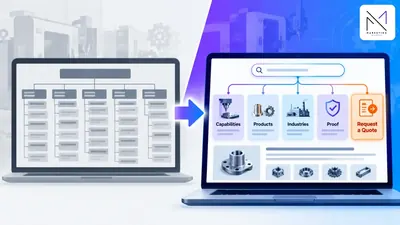
SEO6 min read
Manufacturing SEO Keywords: The Words Industrial Buyers Actually Type
A purchase manager in Chakan needs a new supplier. They do not type your brand name. SEO for manufacturers starts with the words buyers actually use.

Sagar MamureMechanical engineer turned marketer · Founder, Marketing Mantra
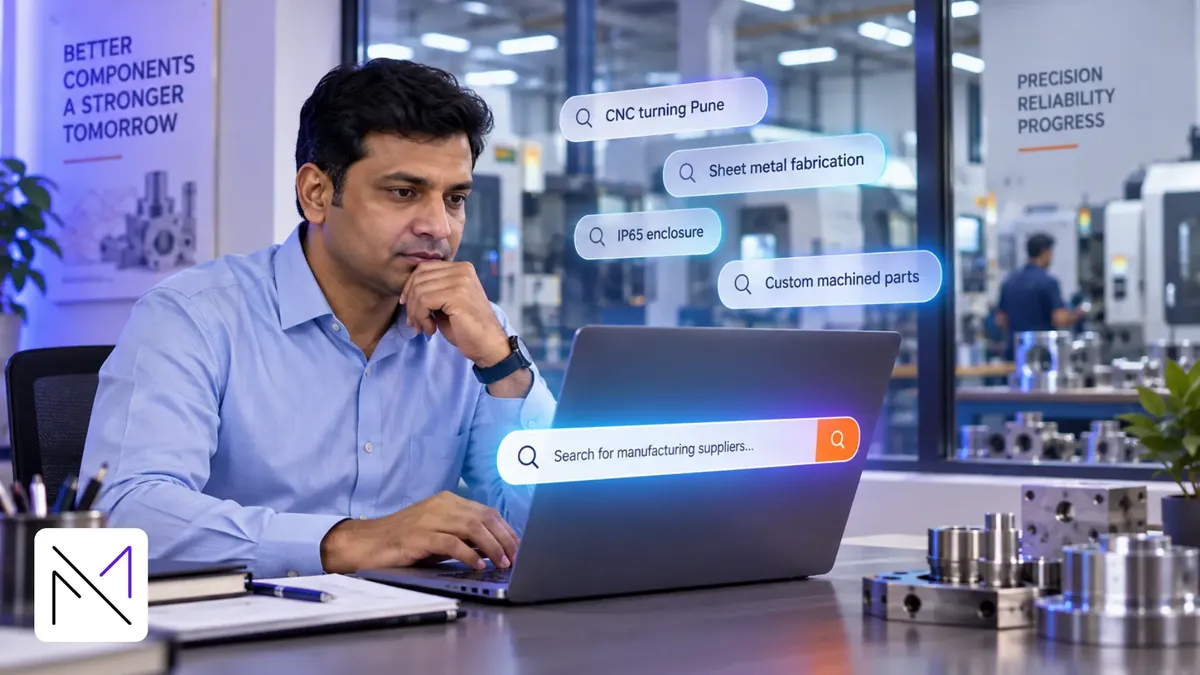
A purchase manager in Chakan
A purchase manager at an auto component plant needs a new supplier. They search:
Then they narrow it down:
They never type your brand name, and they never type the product code printed in your catalogue.
SEO for manufacturing companies starts exactly here: with the words your buyers type, not the names your company uses internally.
Why don’t product names work as keywords?
Internal product codes and brand names only help buyers who already know you.
New buyers describe their need in their own words:
“XL-400 Series Hydraulic Power Pack”
“hydraulic power pack for press machine”
Most of the research happens before your sales team is involved, so the shortlist often forms without you.
67%
of B2B buyers prefer a rep-free buying experience
45%
of B2B buyers used AI during a recent purchase
Source: Gartner sales survey, March 2026
Searching your own company name is a poor test. It only proves one thing: people who already know you can find you.
What are the five types of manufacturing keywords?
Manufacturing buyers search in five distinct ways, and each one signals a different stage of the buying journey.
| Keyword type | What the buyer types | What the buyer wants | Best page |
|---|---|---|---|
| Product + location | “sheet metal fabrication Pune” | A supplier, now | Product page |
| Process or service | “laser cutting job work near me” | Capacity for a job | Capability page |
| Specification | “SS304 electrical enclosure IP65” | An exact technical fit | Spec sheet |
| Problem | “how to reduce porosity in aluminium castings” | A fix for a shop-floor issue | Article |
| Question or comparison | “laser cutting vs plasma cutting cost” | Help to decide | Article or FAQ |
Product + location
The strongest buying intent. Every core product deserves its own page, with the city or industrial belt in the title where relevant.
Process or service
Job shops, CNC units and fabricators need a separate page for each process, because buyers search for capacity.
Specification
Engineers search by grade, rating, size or standard. Clear specification tables win these searches.
Problem
Not ready to buy yet, but looking for someone who understands the issue. Helpful articles reach them early.
Question or comparison
Buyers choosing between options. Honest comparisons build trust.
How do you find the keywords your buyers actually type?
The best keyword data already sits inside your company.
Read your last 50 enquiries and RFQs
Copy the exact phrases buyers used for parts, materials and problems.
Ask your sales team one question
“What do buyers ask on the first call?” Record every answer word for word.
Check IndiaMART or TradeIndia buy leads
See the product terms buyers use.
Type your product into Google
Note autocomplete, the “People also ask” box and related searches.
The Performance report shows queries you already appear for, including those with no clicks.
Check volumes in Keyword Planner
But do not reject a keyword just because volume is low.
Group every phrase into the five types
Then match each group to one page.
In manufacturing, a keyword only a handful of people search each month can still bring one buyer with a large annual requirement. Intent matters far more than volume.
How do you map keywords to pages?
Give every page one main keyword and one clear job. When a single page tries to rank for everything, it usually ranks for nothing.
A fabrication unit with one “Our Products” page listing twelve items should split it into twelve pages, each with specifications, photographs, applications and an RFQ button.
Place the main keyword in six places:
- The SEO title
- The URL
- The H1 heading
- The first 100 words
- At least one image’s alt text, where it describes the image honestly
- The meta description
When I review manufacturing websites, this is the most common gap I see. The products are strong and the factory is capable, but the website describes everything in the company’s language instead of the buyer’s.
What are the most common keyword mistakes?
Most mistakes come from writing in the company’s language instead of the buyer’s.
Internal codes as titles
Page titles that use product codes and brand names.
Broad words only
“Engineering solutions” or “quality manufacturer”, which buyers rarely search.
All products on one page
So no individual product can rank.
No location
Even though many industrial buyers prefer nearby suppliers.
Copied keyword lists
Using a competitor’s list without checking your own buyers use those terms.
Writing only for Google
Ignoring the questions buyers now ask AI tools.
How does AI search change SEO for manufacturers?
AI search raises the value of question and problem keywords, because buyers now ask AI tools full questions.
Add FAQ sections
On product and capability pages, in buyer language.
Use specification tables
Instead of paragraphs, for grades, sizes, tolerances and capacities.
State plainly who you are, what you make and where
“We manufacture hydraulic cylinders for earthmoving OEMs from our plant in Bhosari MIDC, Pune.”
Industrial SEO and AI search optimisation now work as one job. For the page structure that supports both, read how to structure a manufacturing website for industrial SEO.
What should you do this week?
Build a working keyword list in seven days, without paid tools.
| Day | Task |
|---|---|
| Days 1 and 2 | Collect 50 buyer phrases from enquiry emails, RFQs and sales calls |
| Day 3 | Add Google autocomplete and “People also ask” phrases |
| Day 4 | Pull current queries from Google Search Console |
| Day 5 | Sort every phrase into the five keyword types |
| Day 6 | Map each group to a page and list the missing pages |
| Day 7 | Rewrite the titles and H1s of your top three product pages |
Start with your three most profitable products, then add one new product page each week.
Keyword readiness check
5 of 5 unticked. Your website is probably written in your company’s language. Start with the day 1 and 2 task.
Summary
- SEO for manufacturing companies starts with buyer language, not product names or codes.
- Buyers search five ways: product + location, process, specification, problem and question.
- The best keyword data comes from enquiry emails, RFQs and sales calls.
- Give each page one main keyword, and each core product its own page.
- Clear answers, FAQs and specification tables help on Google and in AI search.
Frequently asked questions
How long does SEO take for a manufacturer?
It varies. Specific local keywords can show early movement within a few months; broader, competitive keywords usually take longer. It depends on your current website, competition and how consistently you publish. Rankings cannot be guaranteed.
Should I include my city or industrial area in keywords?
Usually, yes. Many industrial buyers prefer suppliers they can visit or reach quickly. Include your location in relevant page titles and content, and keep your Google Business Profile up to date.
Can I do keyword research without paid tools?
Yes. Enquiry emails, RFQs, sales calls, Google autocomplete, Search Console and Keyword Planner cover most needs for small and mid-sized manufacturers.
Sagar Mamure is the Founder and CEO of Marketing Mantra, a Pune-based marketing, sales and branding consultancy for manufacturing SMEs. A mechanical engineer turned marketer, he helps factories turn their websites and LinkedIn into steady sources of RFQs. Connect on LinkedIn.