Branding4 min read
How to Brand Your Small Manufacturing Business, Without Wasting Money or Time
If you compete only on price, you are already losing. How small manufacturers can build a credible brand without wasting money or time.

Sagar MamureMechanical engineer turned marketer · Founder, Marketing Mantra
Most small manufacturers say the same thing:
“Our quality is good.”
The minimum requirement.
“Our rates are competitive.”
The minimum requirement.
“We deliver on time.”
The minimum requirement.
Good. That's the minimum requirement, not a competitive advantage. If those were enough, you wouldn't be fighting for margins, negotiating on every order, or depending on a handful of repeat customers to survive.
The uncomfortable truth: in today's market, good manufacturing without branding turns you into a commodity. And commodities are always replaceable.
Why does branding matter for small manufacturers?
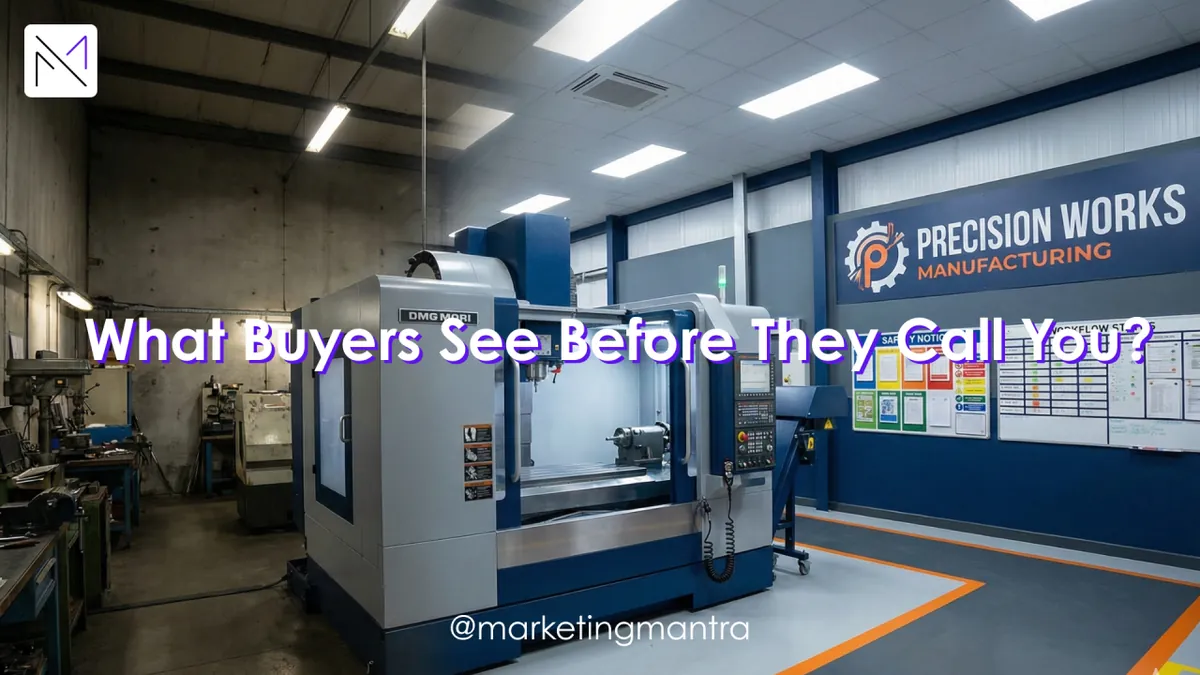
Branding is how the market perceives your reliability before they ever call you.
Let's kill a myth first.
Branding is not
- A logo
- A tagline
- Fancy photos
- Something only big companies need
Branding is
- How the market perceives your reliabilitybefore they ever call you
In manufacturing, buyers don't take risks lightly. A wrong supplier means production delays, quality failures, internal blame and career damage. So buyers don't just evaluate what you make. They evaluate how safe you feel as a decision.
A strong brand:
- Reduces price pressure
- Builds trust before the first meeting
- Shortens the sales cycle
- Makes you look established, even if you're small
If prospects keep asking “Can you handle this?”, “Are you reliable?” or “Have you done this before?”, your brand is not doing its job.
What does ignoring branding really cost?
Most MSME manufacturers delay branding because “we'll do it later”, “we don't have a budget”, or “we get business through references”.
Here's what that delay actually costs you:
- Lower margins
- Slower growth
- Dependence on 2–3 big customers
- Zero bargaining power
- Panic when demand drops
If one customer leaving can shake your business, you don't have stability; you have exposure. Branding is not an expense. It's risk management.
When should a small manufacturer start branding?
Start too early and you waste money. Start too late and you lose position.
Don't start branding yet if
- You're still experimenting
- You don't know your real capability
- You're changing direction every 6 months
Start branding when
- Your product or service works
- You have repeat customers
- You know what you're good at
- You can deliver consistently
Branding amplifies reality. If reality is weak, branding will expose it faster.
Where should you start?
Not with a logo, a website or social media. That's backwards. Start with position, strength and proof, then visuals.
Get brutally clear on your position
Answer in one sentence: “We help ___ industry solve ___ problem better than others because ___.” If you can't answer this clearly, the market definitely can't understand you. “Everything for everyone” is not a positioning; it's confusion.
Define your real strength
Stop saying high quality, best service, competitive pricing. Real branding comes from speed, specialisation, process, reliability under pressure and experience in a niche.
Build proof, not promises
Case studies, process clarity, machinery and capability, certifications, past work and the people behind the operation. If your website and profile look empty, buyers assume the factory is empty too.
Look as professional as you operate
A clean logo, a clear website, consistent messaging and an updated presence that communicate stability, precision, discipline and trust.
“High quality, best service, competitive pricing”
“48-hour prototyping for automotive suppliers” · “Low-volume, high-precision parts for medical OEMs”
Specific is believable. Generic is ignored. And if your branding looks outdated, buyers assume your systems are outdated too. That's not fair, but it's how perception works.
Is branding a campaign or an asset?
Branding is a long-term asset, not a campaign.
Manufacturers often ask, “How many leads will branding give?” Wrong question. Branding:
Makes sales conversations easier
Buyers arrive already trusting you.
Improves lead quality
The right buyers self-select.
Builds recall
You are remembered when the need arises.
Creates leverage
Pricing power and choice of customers.
Sales get you today's orders. Branding protects tomorrow's business. The strongest manufacturers don't chase customers; they attract serious buyers who already trust them.
Brand readiness check
4 of 4 unticked. Your brand is probably underselling your factory. Start with the one-sentence positioning.
Final reality check
You can have good machines, skilled operators and strong processes, and still lose business to a competitor who explains themselves better, looks more credible and feels safer to choose.
Markets don't reward effort. They reward clarity and confidence. If you're serious about growing your manufacturing business, branding is no longer optional. It's infrastructure.
Key takeaways
- Quality, price and delivery are the minimum, not a differentiator.
- Branding is how safe you feel as a decision to a buyer.
- Start with positioning, real strength and proof, then visuals.
- Branding is risk management and a long-term asset, not a campaign.
Sagar Mamure is the Founder and CEO of Marketing Mantra, a Pune-based marketing, sales and branding consultancy for manufacturing SMEs. A mechanical engineer turned marketer, he helps factories turn their websites and LinkedIn into steady sources of RFQs. Connect on LinkedIn.
Originally published in the Marketing Mantra newsletter on LinkedIn.