
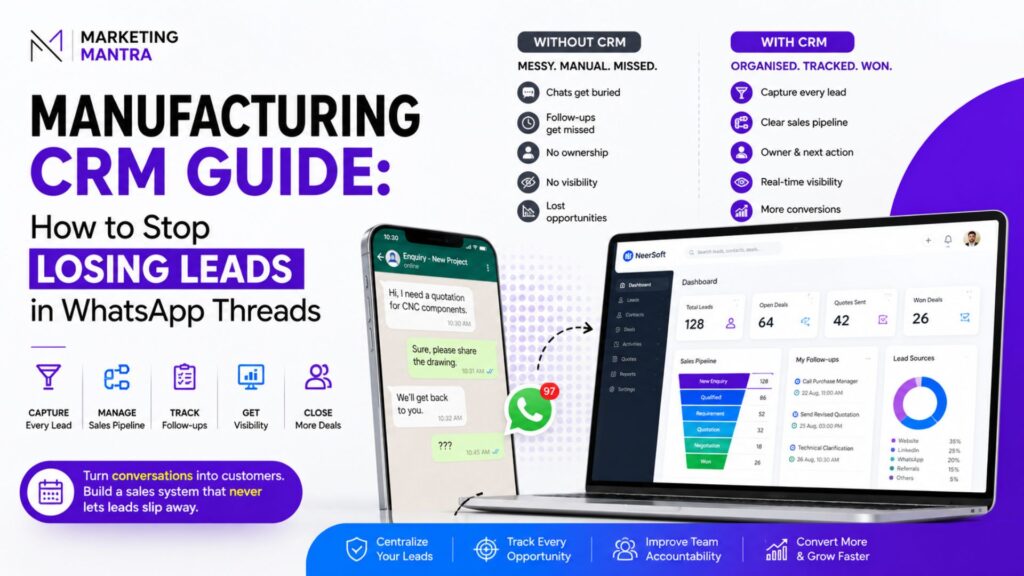
Your biggest sales problem may not be a lack of leads. It may be losing the leads you already have.
A customer sends an enquiry on WhatsApp.
Your salesperson replies.
A quotation is sent.
The customer says:
“We’ll get back to you.”
Then the conversation disappears under dozens of new messages.
A week passes.
Nobody follows up.
The customer moves to another supplier.
This is not a WhatsApp problem.
It is a sales management problem.
Why WhatsApp Cannot Be Your CRM
WhatsApp is excellent for communication.
It is not designed to give management a complete view of the sales pipeline.
Can you easily answer:
- How many enquiries came this month?
- Which quotations are pending?
- Which leads need follow-up today?
- Which salespeople have the most active opportunities?
- Which lead sources generate the most revenue?
- How many enquiries turned into orders?
If the answer requires opening multiple phones and WhatsApp chats, you have a visibility problem.
What Is a CRM?
CRM stands for Customer Relationship Management.
A CRM centralizes:
- Lead information
- Customer details
- Sales opportunities
- Follow-up tasks
- Deal stages
- Notes
- Quotations
- Sales activities
Instead of relying on employee memory, you create a company-owned system.
1. Capture Every Lead
A good CRM process should capture leads from:
- Website
- Referrals
- Exhibitions
- Cold outreach
It doesn’t matter where the lead comes from.
It should end up in one system.
2. Create a Clear Sales Pipeline
For a manufacturing company, a basic pipeline might be:
New Enquiry → Qualified → Requirement Received → Quotation → Follow-up → Negotiation → Won/Lost
Now management can see where every opportunity is.
3. Give Every Lead an Owner
Every opportunity needs one accountable person.
The CRM should clearly show:
Lead → Owner → Stage → Value → Next Action
This eliminates:
“I thought someone else was following up.”
4. Never Leave a Lead Without a Next Action
Every open deal should have a next step.
For example:
Call Purchase Manager — 22 August
or
Send revised quotation — 25 August
This simple discipline can prevent many forgotten opportunities.
5. Track Quotations Properly
A quotation is not the end of the sales process.
It should trigger follow-up.
Track:
- Quotation date
- Value
- Customer
- Responsible salesperson
- Next follow-up
- Current stage
- Outcome
6. Build Customer History
Imagine your salesperson leaves the company.
What happens to the relationships?
If everything exists inside one person’s WhatsApp, you have a major business risk.
A CRM keeps customer history with the company.
7. Review the Pipeline Weekly
A CRM becomes useful when management uses it.
Every week, review:
- New enquiries
- High-value deals
- Overdue follow-ups
- Quotations sent
- Stuck opportunities
- Won deals
- Lost deals
The meeting should start with the CRM—not with:
“So, what is happening?”
NeerSoft CRM as an Option for Growing Teams
Manufacturers evaluating CRM software can explore solutions such as NeerSoft CRM, particularly if they want to move from fragmented lead handling to a centralized process.
NeerSoft’s CRM offering includes features around lead tracking, follow-up management, sales pipelines, team collaboration, reporting and integrations.
You can learn more here:
The important point is not simply choosing a software platform.
Your CRM must match your actual sales process.
A complex CRM nobody uses is worse than a simple CRM your entire sales team updates every day.
A Practical CRM Implementation Plan
Week 1: Map the Process
Document your actual sales journey.
Week 2: Configure the CRM
Create stages, fields, owners and reports.
Week 3: Import Active Leads
Move relevant leads from spreadsheets and other systems.
Week 4: Train the Team
Create one rule:
If a lead isn’t in the CRM, it doesn’t exist in the sales pipeline.
FAQs
Can WhatsApp be integrated with CRM?
Depending on the CRM and setup, WhatsApp can be connected or supported through integrations. The exact workflow should be evaluated before implementation.
Do small manufacturers really need a CRM?
If the company has multiple enquiries, salespeople, quotations or follow-ups, CRM can provide much-needed visibility.
Is Excel enough?
Excel can work for simple tracking, but it becomes difficult to manage as lead volume, team size and sales complexity increase.
What is the biggest CRM mistake?
Buying software without defining the sales process first.
Which CRM should a manufacturer choose?
Choose based on your sales process, team adoption, integrations, reporting requirements and budget—not just the number of features.
Summary
The objective of CRM is not to create more administration.
It’s to make sure:
Every lead is captured.
Every lead has an owner.
Every quotation is tracked.
Every follow-up has a date.
Management can see the pipeline.
WhatsApp should remain a communication channel.
Your CRM should remain the system of record.